Like the placement of your flower tattoo, but want a change?
You like where your tattoo sits, but the flower no longer feels quite like you. If you have other tattoos nearby, you may also wonder how a new design would fit alongside them.
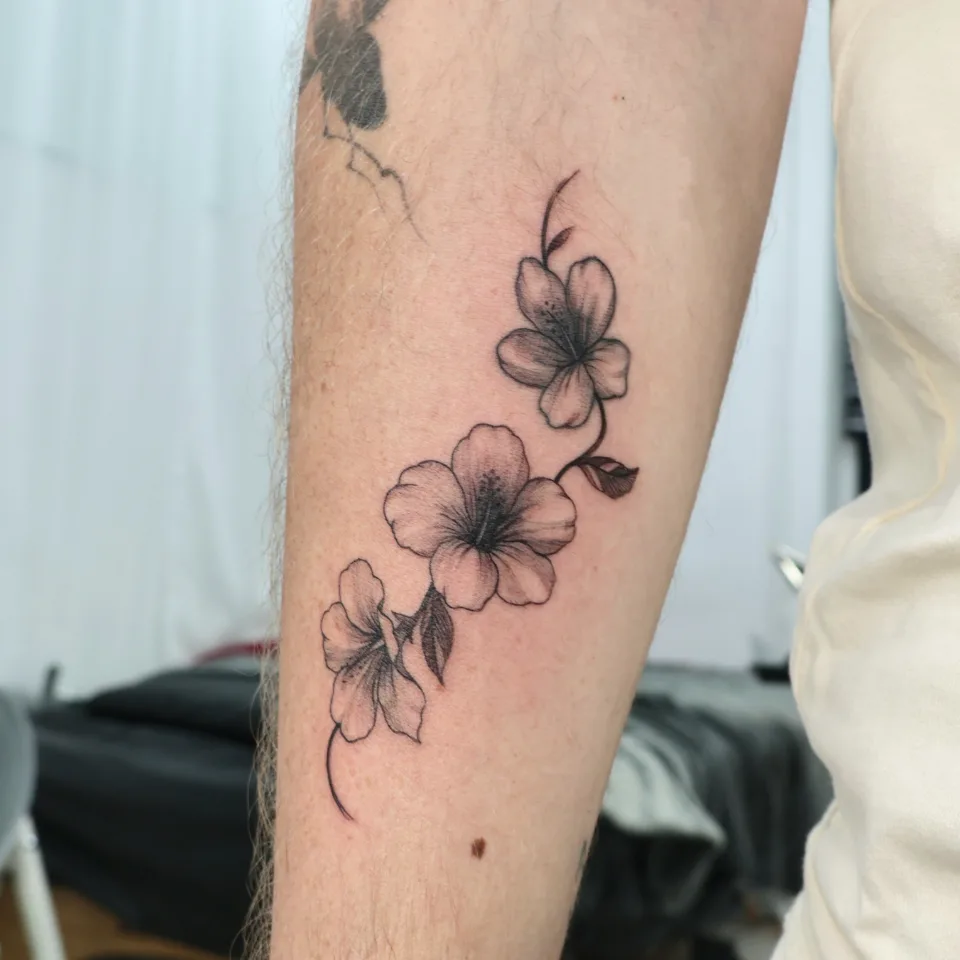
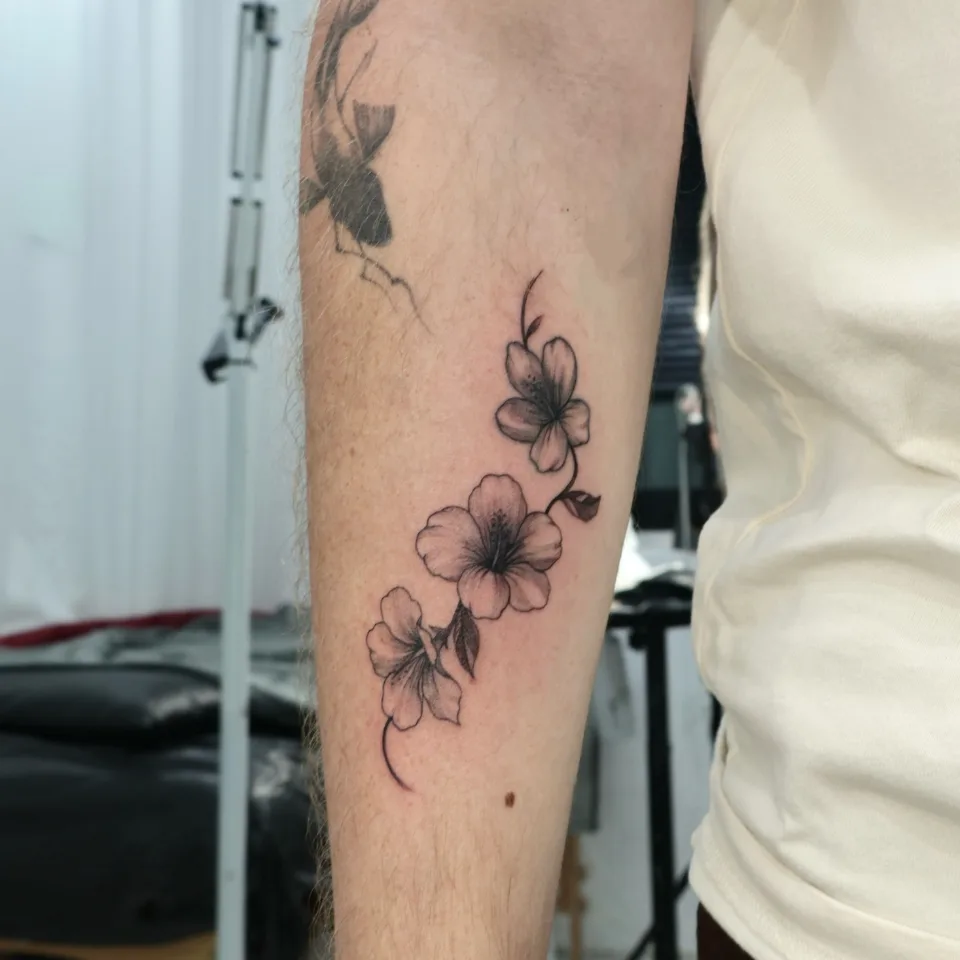
For this tattoo rework in Seoul, Yeonjae kept the placement of the original cherry blossom and developed it into three mugunghwa flowers flowing along the arm. Mugunghwa is also known as rose of Sharon. The photographs show refined petal shapes and shading, with branches and leaves shaping the composition along the arm.
“Could my tattoo be changed like this?” may be the first question the photographs bring to mind. Start by looking at what was kept and how the composition changed, rather than only choosing a flower name. Even if you like the same mugunghwa motif, your starting lines and scale will be different. We will look at the visible changes in this individual piece and the questions to bring to your own consultation.
Mugunghwa tattoo rework: compare the before and after
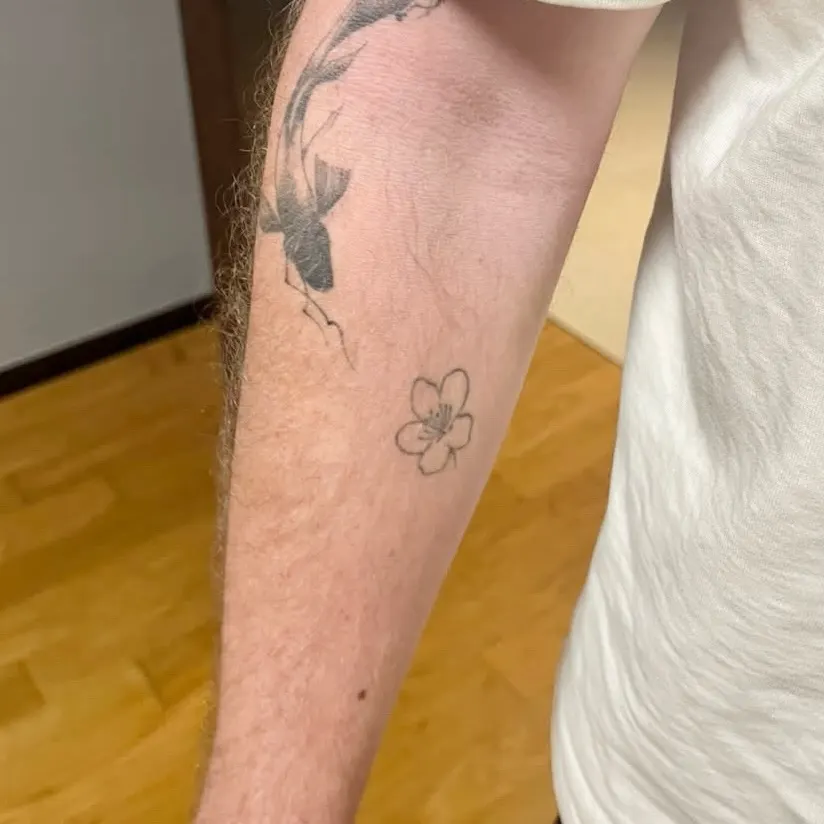
The earlier photo shows a small flower outline; the finished piece has three mugunghwa flowers extending along the arm. Look at the wider view as well as the close-up. Including the tattoo higher on the arm makes the change in composition easier to see.
| Detail | Before the rework | After the rework |
|---|---|---|
| Floral composition | A small flower outline remains | Three mugunghwa flowers form the arrangement |
| Petals and centres | Existing lines are visible | Petal lines and central shading are refined |
| Surrounding tattoos | Another tattoo sits above the flower | Added branches and leaves shape the flow along the arm |
| Placement | The original flower sits on the arm | The rework keeps the original placement |
The arrangement now draws the eye along the arm, starting from the placement of the original flower. The wider photo shows how it sits alongside the existing tattoo above it.
Use each view for a different purpose. Inspect the petal lines in the finished close-up, look at the space between this piece and the tattoo higher on the arm in the wider view, then locate the original small flower in the earlier photograph. The camera distance and angle differ, so the photographs do not establish exact size changes or show skin-color differences as a treatment effect. Focus on the visible change in composition when deciding what to ask about.
Fine lines, open space and a flower with room to breathe
The petals are not filled edge to edge. Dark shading gathers at the centres, while fine lines and open skin leave the outer petals lighter. That contrast gives each flower a defined centre without making the petals feel heavy.
- Petal lines: Follow the fine marks radiating out from each centre.
- Shading and open space: Notice how the darker centres sit against the lighter petals.
- Curving branches: The three flowers face different directions, with branches carrying the eye between them.
Is there a detail you would like in your own tattoo? “I like the open space in these petals,” or “I would like the flowers to flow along my arm” is enough to start explaining it. Pick out what draws you to the piece; you do not need to arrive with the whole design worked out.
A rework or a cover-up? Begin with what you want to change
Do you need to choose the technical term first? You can start more clearly with what you want to keep and what you want to change. “I like the placement, but want to change the petals,” “I would like it to sit more comfortably beside my other tattoos,” or “I would like the old lines to draw less attention” describes a preference without prescribing a technique.
The original caption explains that Yeonjae adjusted the petal shapes, line flow and shading rather than simply covering the cherry blossom. It also describes adding and refining branches and leaves to connect the composition with nearby tattoos. This is a visible example of keeping the original place while changing the design’s character; it does not mean every existing tattoo can be changed in the same way.
Make two short notes: what to keep, and what to change. One detail is enough to begin. You can send a flower reference or describe the feeling you prefer. The design’s scale and the scope of the changes are discussed alongside your current tattoo and the result you have in mind.
Photographs cannot establish every aspect of the existing ink or predict the outcome of future work. This before-and-after example is a design reference, not a promise of the same result. Discuss the approach and individual details with the artist.
Which photographs should you send?
A clear view of the tattoo’s lines is a useful starting point. A second, wider photograph can show how it sits beside other work. That is why this article includes a finished close-up, a wider finished view and an earlier photograph: each helps you examine a different part of the composition.
- Close-up: Choose a focused photograph in which the tattoo is clearly visible.
- Wider view: Include the same placement and nearby tattoos.
- Reference: Pick a flower or line style you like, with one sentence explaining the detail that appeals to you.
- Size note: Give an approximate measurement in centimetres for the existing work and the idea, if you know it.
A photograph that shows the current lines helps you explain what you would like to preserve. Choose images where the design and its surroundings are visible rather than cropped away or obscured by a filter. There is no need to retouch the tattoo’s lines for an inquiry.
For example: “I want to keep the flower’s placement but make the petals feel lighter. I have also included a view of the tattoo above it.” You do not need specialist terms or a finished design to start a conversation. If the size or visit date is undecided, say so.
Start your inquiry with a photo and an idea
You do not need a finished design or a decision about the rework technique. Send a current photo and what you would like to change to @yeonjae_tattoo on Instagram. Include whatever you know from the list below.
- Current photos: A close-up and a wider view that includes nearby tattoos.
- What to keep: The placement or a shape you still like.
- What to change: A flower, a mood, or a detail from this piece that appeals to you.
- Size, placement and visit dates: Share any preferences you have; anything undecided can be part of the conversation.
Keep the place you love. Find a flower that feels like you.
This mugunghwa rework keeps the original placement while reshaping the petals, shading and flow along the arm. If the fine lines, open space and three-flower arrangement appeal to you, think about what you would like to keep in your own piece.
“I want to keep the placement, but change the feel of the flower.” A sentence like that and a current photo are enough to begin an inquiry. Message @yeonjae_tattoo on Instagram to discuss your idea with Yeonjae in Hongdae, Seoul.
Sources for this article
This article is based on Yeonjae’s original Instagram caption and three real photographs of the work.
The number of flowers, the open space and the placement of the lines come from what is visible in the photos. The note that cherry blossom was reworked into mugunghwa by adjusting petals, lines, shading and branches comes from the caption.
The work shown is by Yeonjae, in her eighth year as a tattoo artist in Hongdae, Seoul, as of 2026. The original caption is in the source record below.
Before you book
Should I ask about a tattoo rework or a cover-up?
This piece is a rework that keeps the placement of an existing cherry blossom tattoo and changes it to mugunghwa. You do not need to settle on a term before inquiring. Send a photo and explain what you want to preserve and what you want to conceal.
Could I choose a different flower instead of mugunghwa?
Share the flower you have in mind during the consultation. Possible changes depend on the existing lines, color, size and surrounding composition. This individual example does not establish what can be achieved on every tattoo.
How do I find out the price and session length?
Send current photos, your preferred size and the changes you have in mind to @yeonjae_tattoo on Instagram. Price and session length can be discussed alongside the possible scope of the rework.
Key facts
- Location
- 2F, G Studio, 136-11 Eoulmadang-ro, Mapo-gu, Seoul, South Korea
- Opening hours
- Mon–Sat 11:00–23:00 · Closed on Sundays
- Artist
- Yeonjae · China Academy of Art graduate · eighth year in Hongdae (as of 2026)
- Styles
- Fine line · Floral & botanical · Cover-up
- Consultation & booking
- Confirmed after consultation via Instagram DM, LINE or KakaoTalk
- Pricing & time
- Price and session length depend on the design, size and placement, and are explained during the consultation.
China Academy of Art graduate, in her eighth year as a tattoo artist in Hongdae · as of 2026
China Academy of Art is an art university founded in Hangzhou in 1928. Its long history of art education provides context for Yeonjae’s fine-art background. About the academy · official website ↗
Yeonjae Tattoo · Blog
This post brings together the work photographs, published descriptions and guidance for preparing an inquiry. See the artist profile above for the creator’s background.
Photo source: Original artwork & context ↗