What tattoo types are there, and how do you tell them apart?
Hi, I'm Yeonjae, a tattoo artist in Hongdae, Seoul. If you are wondering what tattoo types there are, the short answer is that people usually sort them by how the design is drawn: thin, delicate lines (fine-line), soft shading in darker and lighter tones of black ink (black and grey), bold outlines with a playful old-school feel, and cover-ups, which are designs planned around a tattoo that already exists. In this article I use three pieces from the studio to show how those differences look in real work.
A style is less a strict rule than a bundle of choices: how thick the line is, whether there is shading, how much skin is left empty, and how large the piece is and where it sits. Seeing those choices in actual photos usually explains more than a definition does. All three pieces here also happen to be travel memories, which is a good reminder that the style should serve the memory, not the other way around.
Here is a quick overview of how the pieces in this article map onto the styles:
| Type | What you notice first | Example in this article |
|---|---|---|
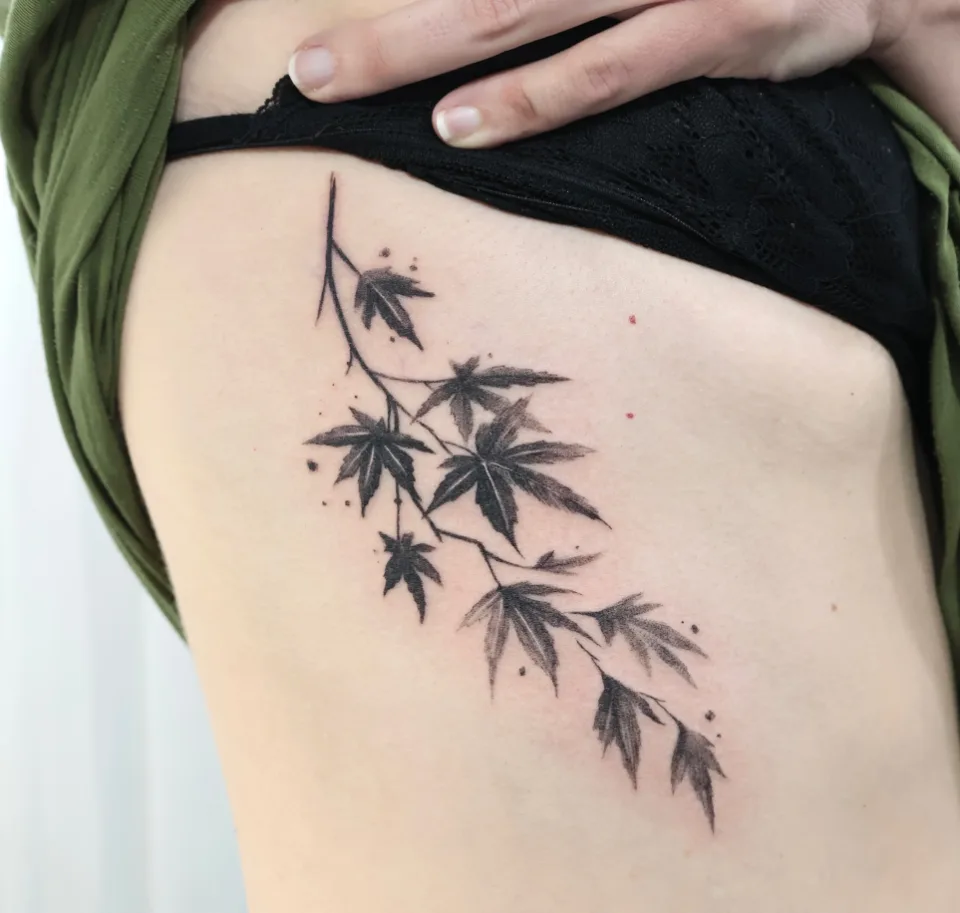
| Black and grey | Dark areas and pale gray shading working together | Maple branch on the side of the body |
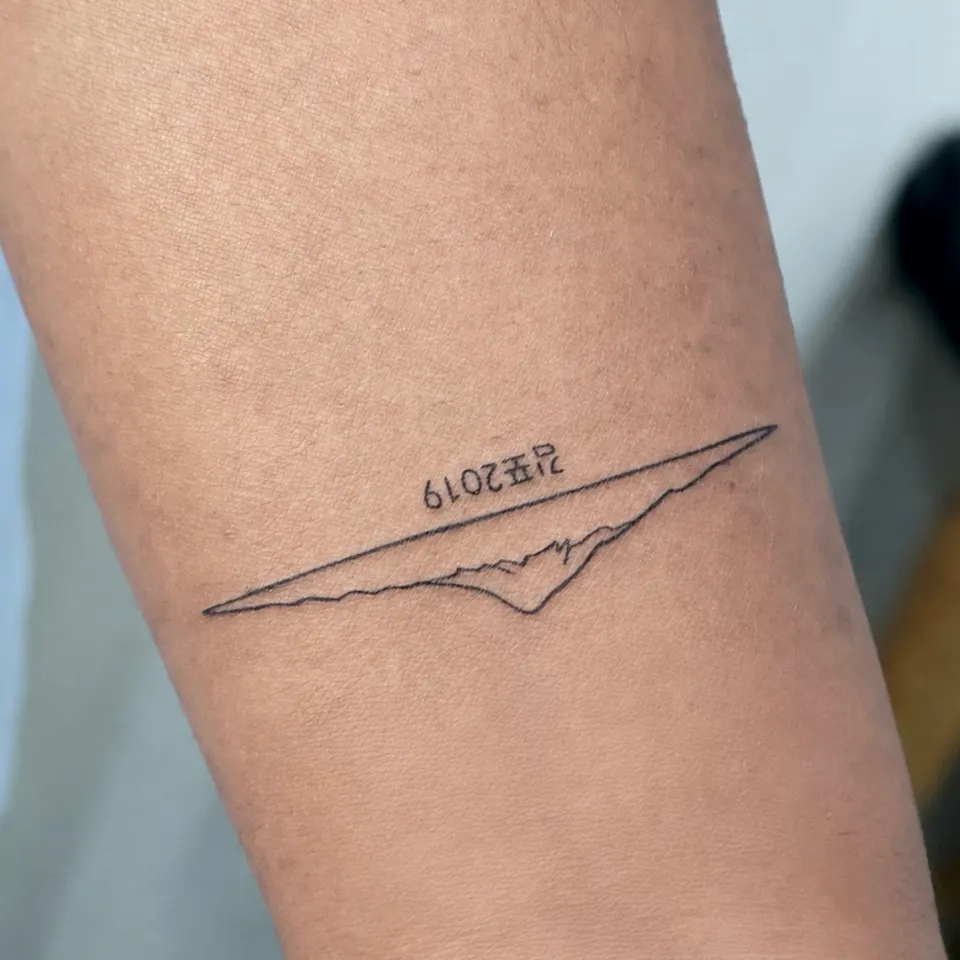
| Fine-line | A thin line doing most of the work | One-line mountain on the forearm |
| Old-school | Bold outline that stays readable at a small size | Penguin character on the ankle |
| Cover-up | A new design built around an existing tattoo | No work photo here, so general notes only |
I want to be upfront about one thing. The photos I have for this article cover black and grey, fine-line and old-school work. There is no cover-up photo, so that part stays general and I will not pretend otherwise.
How does a black and grey tattoo look in a real piece like the maple branch?
This client from Australia loves traveling and collecting meaningful memories through tattoos from each country they visit. During this trip, they were especially impressed by the autumn maple trees in Korea. They told me that Australia doesn't really have the same kind of autumn season or falling maple leaves, so the scenery felt very special and beautiful to them. Wanting to keep that memory forever, they chose to capture it as a tattoo.
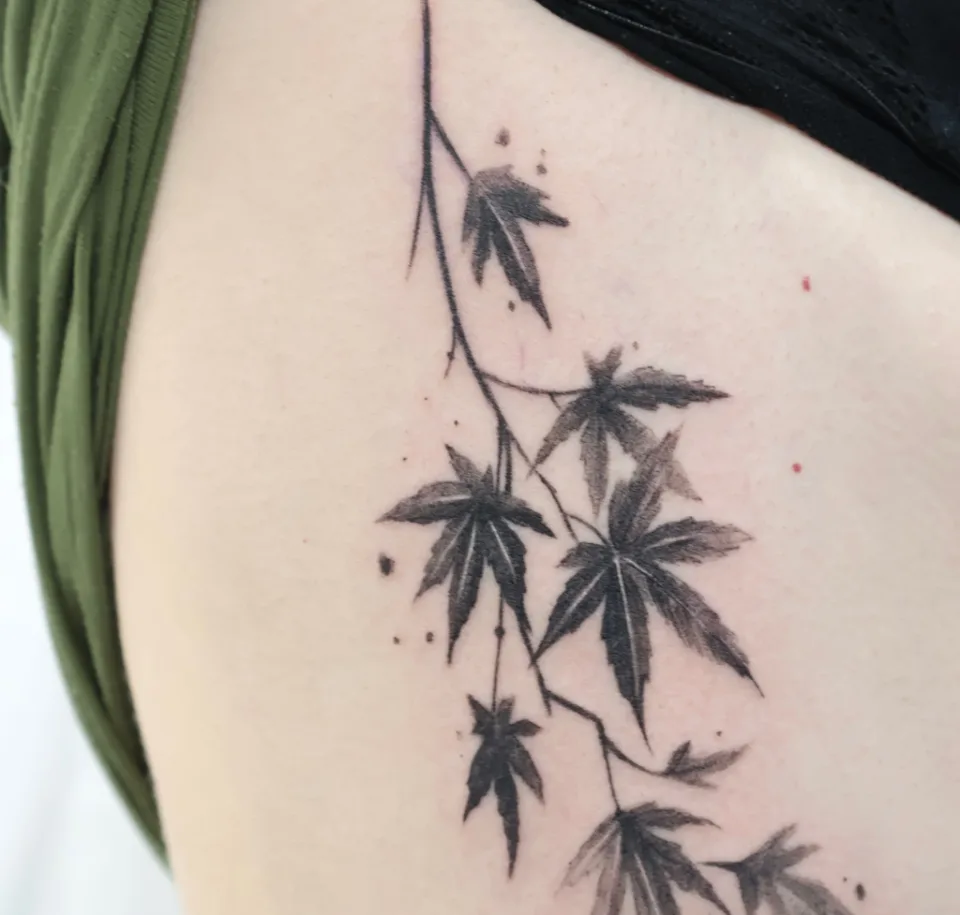
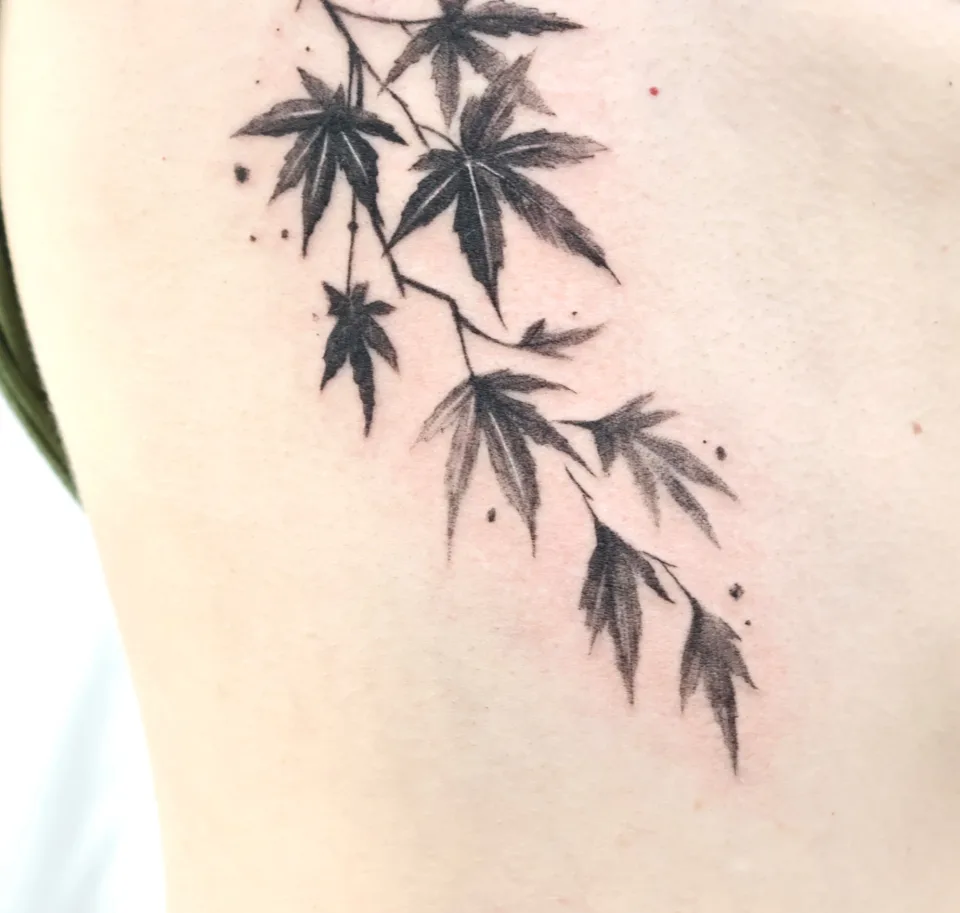
Looking at the full photo, the branch comes diagonally down the side of the body with several maple leaves along it, and small dots are scattered around the branch. Those dots are a quiet detail: they suggest leaves in the air without adding more full leaves, so the composition keeps some space around it.
The close-ups show what makes this black and grey. At the top, leaves split off a thin stem, and the leaf veins are left open so they read like pale lines. Lower down, each leaf mixes dark parts with light gray shading, and a long-tipped leaf hangs downward. Because the piece is built only from black ink in darker and lighter tones, the leaves get a sense of depth without any color.
If you are drawn to this style, a useful question to ask yourself is how much softness you want. Black and grey gives you a range from deep dark areas to almost-empty light areas, and deciding where the light areas go, such as the veins here, is a big part of how the final piece reads.
What makes a fine-line tattoo different, and how do you choose the words for one?
This piece started as a travel memory captured in one simple line. A friend of mine visited Korea and chose a word in Korean to remember the trip. The mountain silhouette is inspired by Mount Fuji, a place we also visited together in Japan. As I like to say, sometimes the simplest tattoos carry the biggest memories.
In the photo, a single thin line forms an elongated triangle on the forearm, with a mountain ridge running inside it and letters and numbers placed above. (The photo shows the lettering upside down relative to the image, so it can be read from the wearer's side.) Almost nothing is happening in this design except the line, which is exactly what makes it fine-line: the line itself is the whole drawing.
When a design is this simple, every decision shows. Many people find it helps to think about three things before choosing a fine-line piece:
- The shape: a single continuous outline keeps the idea clear.
- The words: short text tied to a real memory tends to feel more personal than a long phrase.
- The placement: a long, narrow area such as the forearm suits a long, narrow shape like this one.
If you want lettering in a design like this, it helps to decide what the words are meant to say, and in which language, before you decide how they look. The message comes first, and the line weight and spacing follow from it.
Can a small tattoo still be bold and old-school?
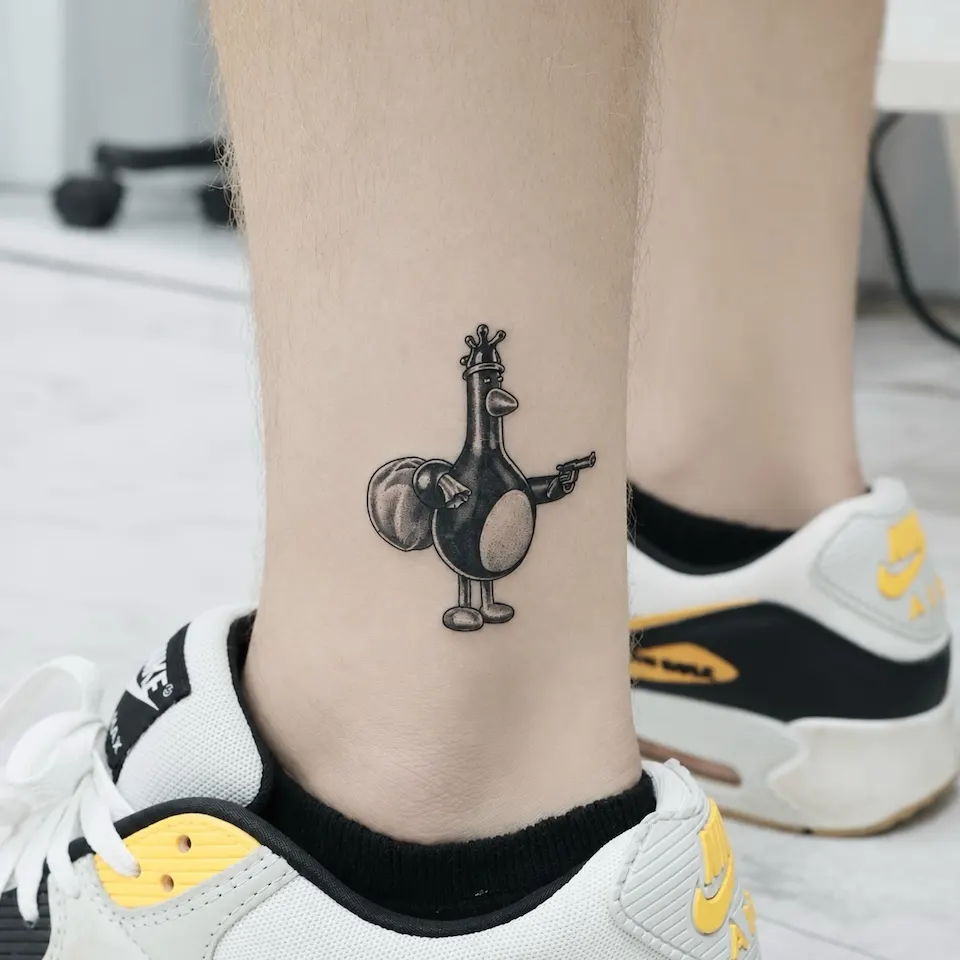
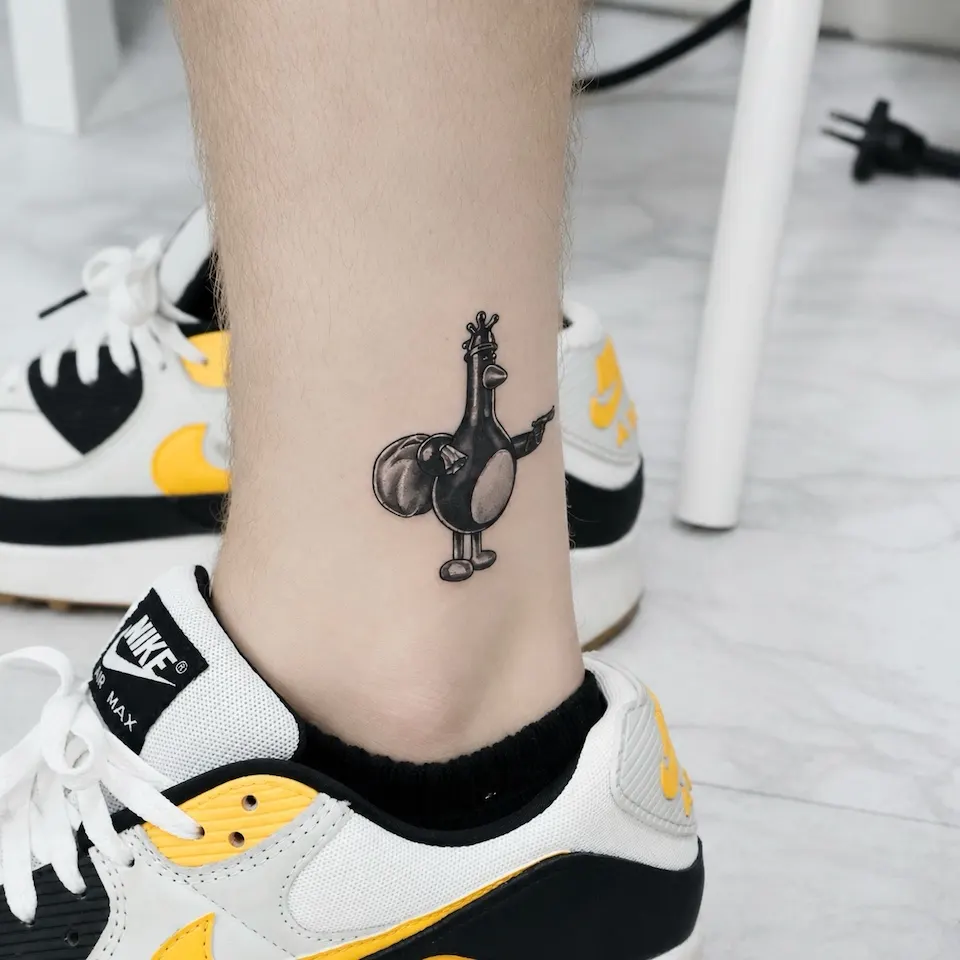
A traveler visiting Korea stopped by the studio for this piece. They chose Feathers McGraw, the iconic villain penguin from Wallace & Gromit, and wanted it tattooed in a playful old-school style on the ankle. Even in a small size, I focused on capturing the character's unique expression and charm while keeping the design bold and readable. Thank you to everyone who visits the studio during a trip.
The photos show how that works. The penguin has a pointed beak, a pointed shape on top of its head, one hand stretched forward and a bundle on its back. From the second angle you can see that the belly is left light while the edges are filled with a dark, bold black outline. That contrast between a heavy outline and a light open area is what keeps a small character readable from a distance.
So old-school, in practice, is about confident outlines and clear shapes rather than lots of fine detail. If you are thinking about a character or a pop-culture favorite, it is worth deciding which one or two features make it recognizable, such as the expression and the silhouette here, and letting the design protect those first.
If you would like to see how pieces like these come together in the studio, you can [watch the tattoo films](/films) to get a feel for the work.
What about cover-up tattoos?
A cover-up is a new design planned to work over a tattoo that already exists. I do not have a cover-up case among the photos for this article, so I will keep this section to general guidance instead of showing a result.
The main idea is that the existing tattoo becomes part of the brief. Its size, how dark it is and where it sits all influence what kind of new design can work. That is why a cover-up is a different conversation from choosing a design on blank skin: you are not only asking what you like, but also what the new piece can realistically do with what is already there.
For that reason, the most helpful thing you can do is bring clear photos of the current tattoo and think about the direction you like, such as shading-based or bold-outline. Whether a cover-up is realistic is something to judge by looking at the actual tattoo in person, so I would not promise any particular outcome ahead of time.
A small note on style: the same vocabulary applies here. Black and grey shading, bold outlines and thin lines are all just tools, and which one fits depends on the situation rather than on a trend.
What do people often wonder when choosing between tattoo types?
Many people ask which style is right for them, and the most honest answer is to start from the memory or idea, not from the style name. The three pieces above all began with a story: autumn leaves seen on a trip, a mountain visited with a friend, a favorite character. The style came after, as the way to show that story clearly.
Another common question is whether a small tattoo has to be simple. Not necessarily, but a small size does mean you should decide what matters most. The penguin keeps its expression through a bold outline, and the mountain keeps its meaning through a single line. Different styles, same principle: choose the one or two details that carry the idea.
Here is a rough guide that many people find useful:
| If you want... | You might lean toward... |
|---|---|
| Soft depth, like leaves or natural scenery | Black and grey |
| A quiet, minimal look with a message | Fine-line |
| A playful character that reads clearly when small | Old-school |
| To rework something that already exists | A cover-up consultation |
This is a starting point, not a rule, and styles can overlap. If you would like to read more about how I think through individual pieces, there are more [work notes in the journal](/journal).
What should be on your tattoo type checklist before a consultation?
Once you have a rough idea of the style you like, a little preparation makes the consultation much more useful. You do not need a finished design. You mostly need to know what you want the tattoo to say and where you picture it.
Here is a simple checklist you can go through before you get in touch:
- [ ] I can say in one sentence what memory or idea the tattoo is about.
- [ ] I have a few reference images that show the line weight and shading I like.
- [ ] I have an idea of the placement and roughly how big it should be.
- [ ] If it includes words, I know the exact wording and the language.
- [ ] If it is a cover-up, I have clear photos of the existing tattoo.
- [ ] I know which one or two details matter most to me.
If you are visiting Seoul, my [Hongdae tattoo guide](/hongdae-tattoo) gives some background on the area and the studio. Bringing your checklist and references makes it easier to talk through style, size and placement together.
Let’s talk about a tattoo that feels like you
Bring reference photos and tell us your preferred motif, size and placement.
Before you book
What are the main tattoo types?
People commonly group tattoos by how they are drawn: fine-line (thin, delicate lines), black and grey (shading in tones of black ink), old-school (bold outlines and clear shapes) and cover-ups (designs planned around an existing tattoo). The styles can overlap, and a single piece can borrow ideas from more than one.
How do I choose between fine-line and black and grey?
Think about the feeling you want. If you want a quiet, minimal piece where a line carries the idea, fine-line may suit you. If you want depth and soft shading, like leaves or scenery, black and grey is worth looking at. Reference images help a lot in deciding.
Can a small tattoo be detailed and bold at the same time?
A small tattoo usually works best when you choose the one or two features that matter most and let the design protect them. A bold outline with open light areas, as in the ankle penguin, is one way to keep a small design readable.
What should I bring if I want a cover-up?
Clear photos of the existing tattoo and a few references for the direction you like are a good start. Whether a cover-up is realistic is best judged by seeing the tattoo in person, so it is a good idea to come with an open mind about the result.
Key facts
- Location
- 2F, G Studio, 136-11 Eoulmadang-ro, Mapo-gu, Seoul, South Korea
- Opening hours
- Mon–Sat 11:00–23:00 · Closed on Sundays
- Artist
- Yeonjae · China Academy of Art graduate · eighth year in Hongdae (as of 2026)
- Styles
- Fine line · Floral & botanical · Cover-up
- Consultation & booking
- Confirmed after consultation via Instagram DM, LINE or KakaoTalk
- Pricing & time
- Price and session length depend on the design, size and placement, and are explained during the consultation.
China Academy of Art graduate, in her eighth year as a tattoo artist in Hongdae · as of 2026
China Academy of Art is an art university founded in Hangzhou in 1928. Its long history of art education provides context for Yeonjae’s fine-art background. About the academy · official website ↗
Yeonjae Tattoo · Blog
This post brings together the work photographs, published descriptions and guidance for preparing an inquiry. See the artist profile above for the creator’s background.
Photo source: Original artwork & context ↗
Original Instagram caption
Based on the artist’s supplied work notes. Editorial text was prepared with AI assistance.