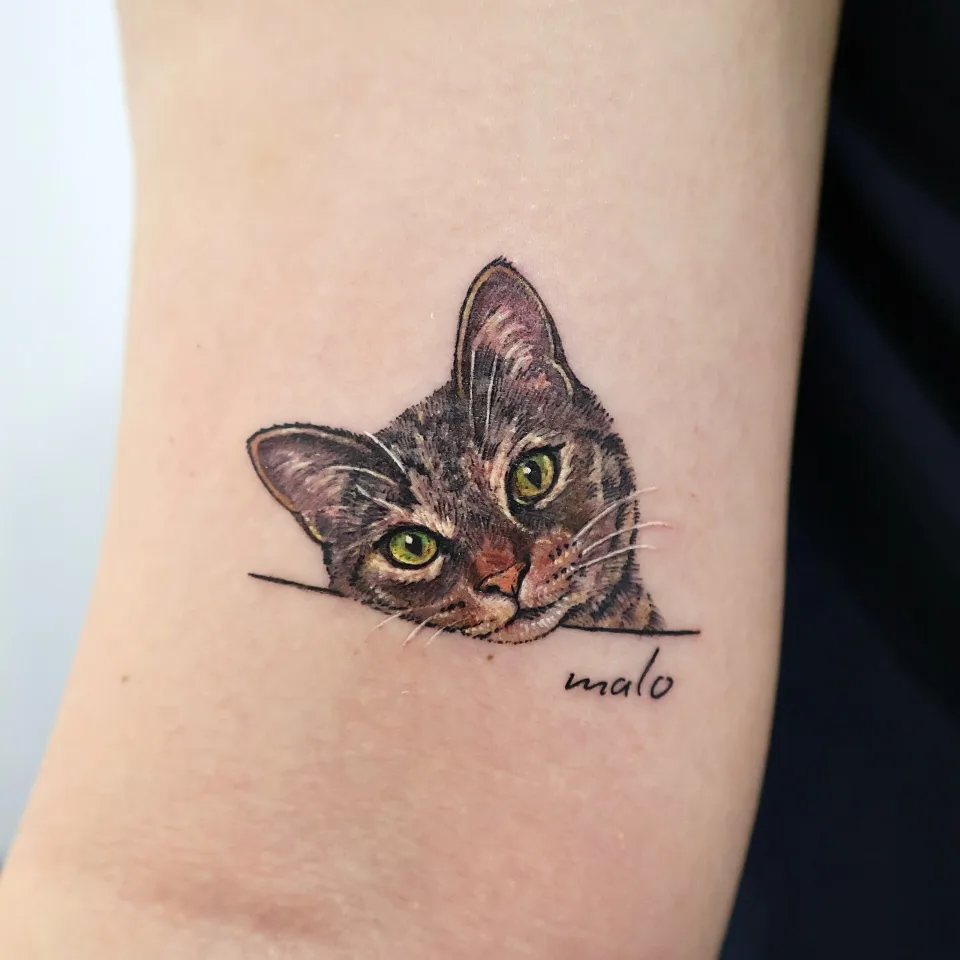
What did this cat tattoo capture, and where does it sit?
Hi, I'm Yeonjae, a tattoo artist in Hongdae, Seoul.
Today I'd like to share a cat tattoo I did recently. If you want to get your beloved cat tattooed but are unsure which reference photos to bring and how to capture the face, and that has made you hesitate before a Hongdae tattoo consultation, this piece is a good place to start.
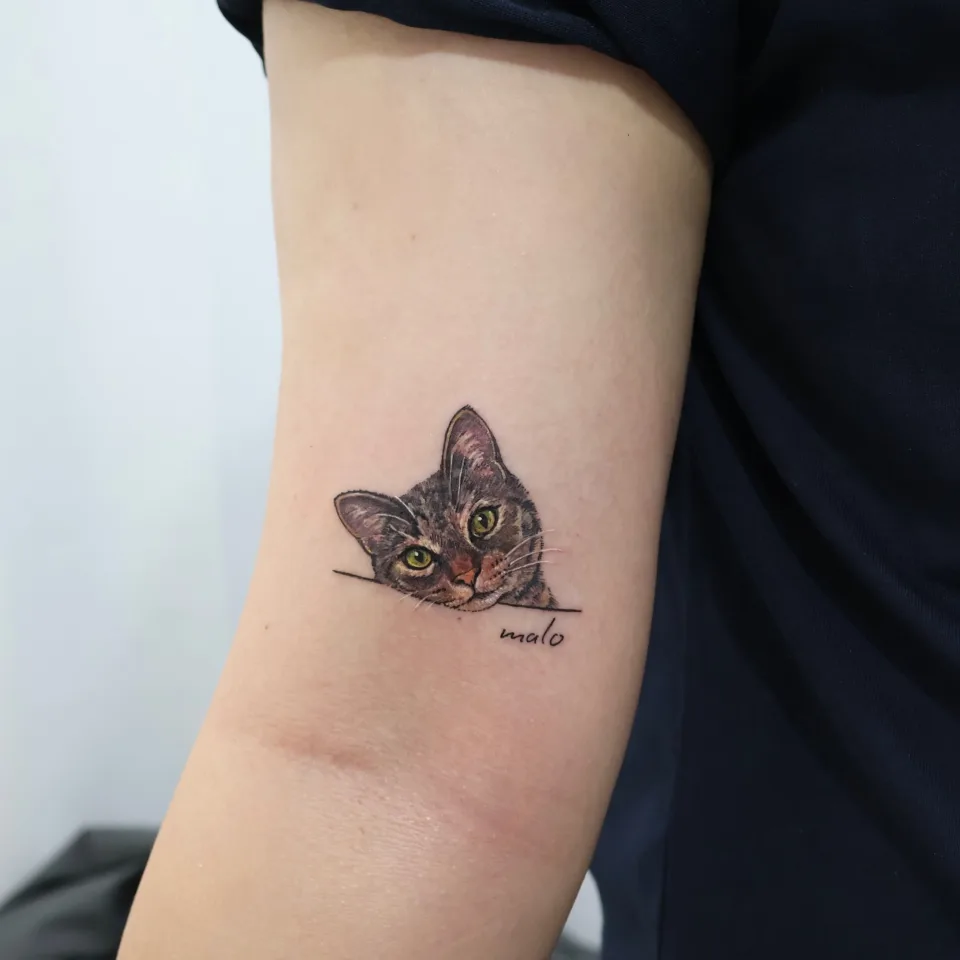
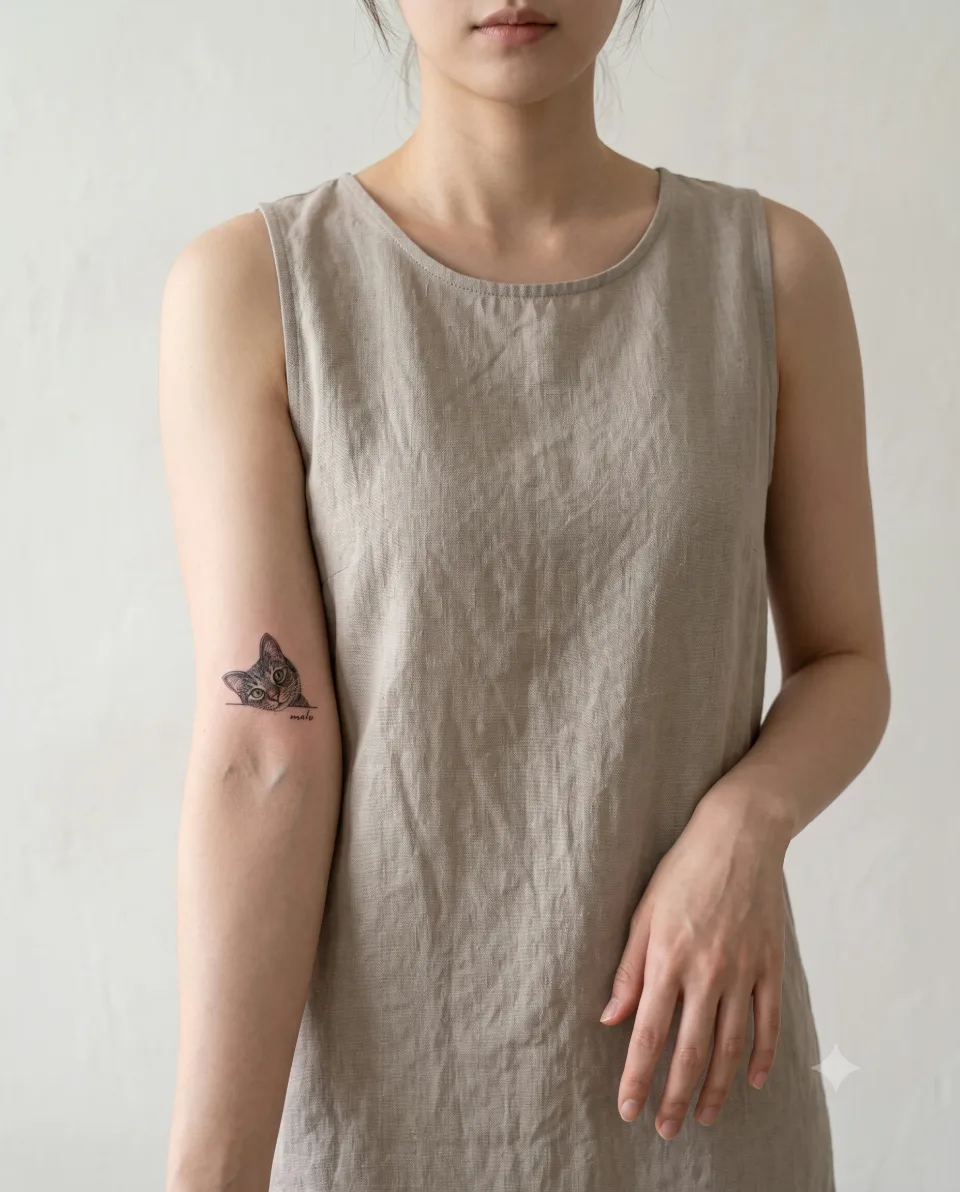
The first photo shows a small colour cat face on the arm. The cat tilts its head and peeks over a thin line, with a small cursive word below the line. The fur is green-brown striped, the eyes are yellow-green, and the whiskers are drawn in white lines. In photo 2 you can see it sits small on the inner upper arm. In the post I described it as a small tattoo of a beloved cat, a little piece of home always kept close.
A cat portrait tattoo gets easier when reference photos settle three things first: face proportions, fur direction and eye expression. A front-facing photo at eye level helps with proportions, a sharp photo where the fur direction shows helps with the fur, and a photo with light in the eyes helps with eye expression. You're welcome to ask about price and session length when we meet to talk.
Which other cats and animals did the other pieces capture?
Even among cat tattoos, the reference photos you need change with the composition. Here is how each cat post describes its piece.
| Photo | Shape and composition | What the post says |
|---|---|---|
| 3, 4 | A grey tabby and an orange kitten, with two lines of English text below. Photo 4 is an image of the two cats on a white background | A realistic cat tattoo: a tiny portrait of two beloved cats, capturing a special memory forever |
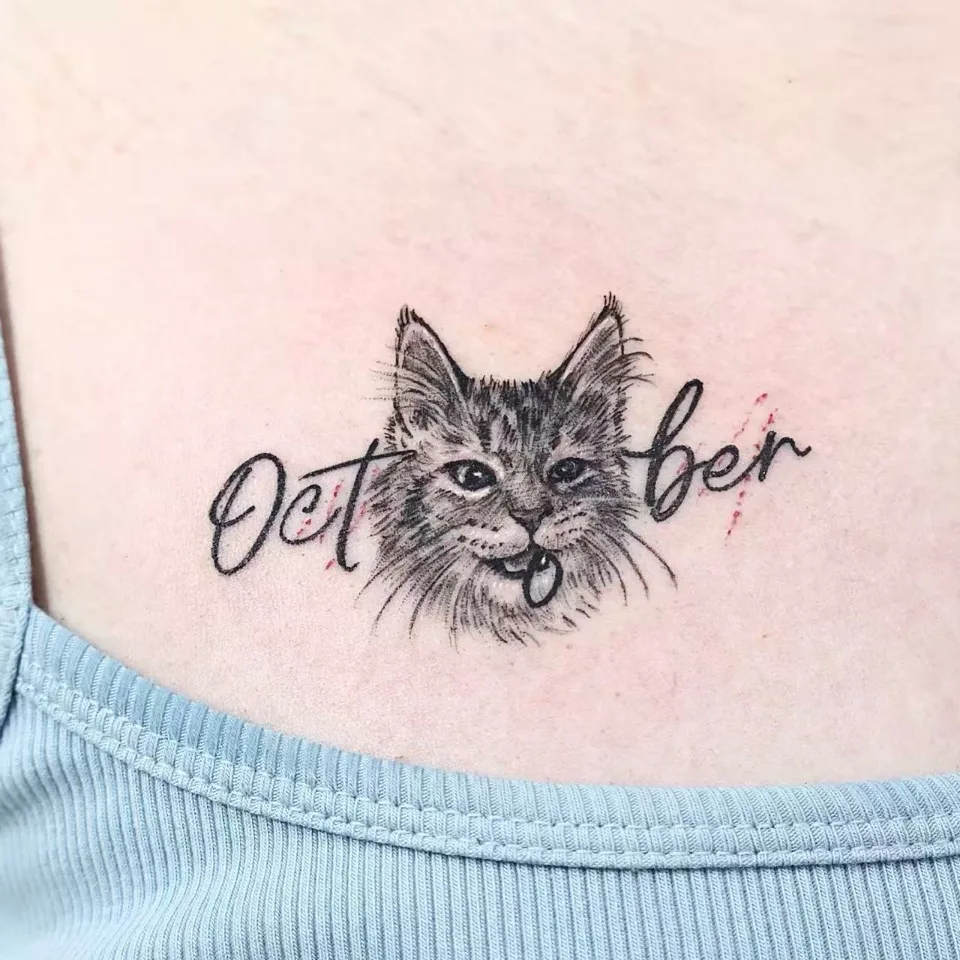
| 5 | A black and grey cat face set between cursive letters, with red lines around it | A playful little cat full of mischief and charm. The red marks behind are tiny scratch traces, like a memory of their wild personality |
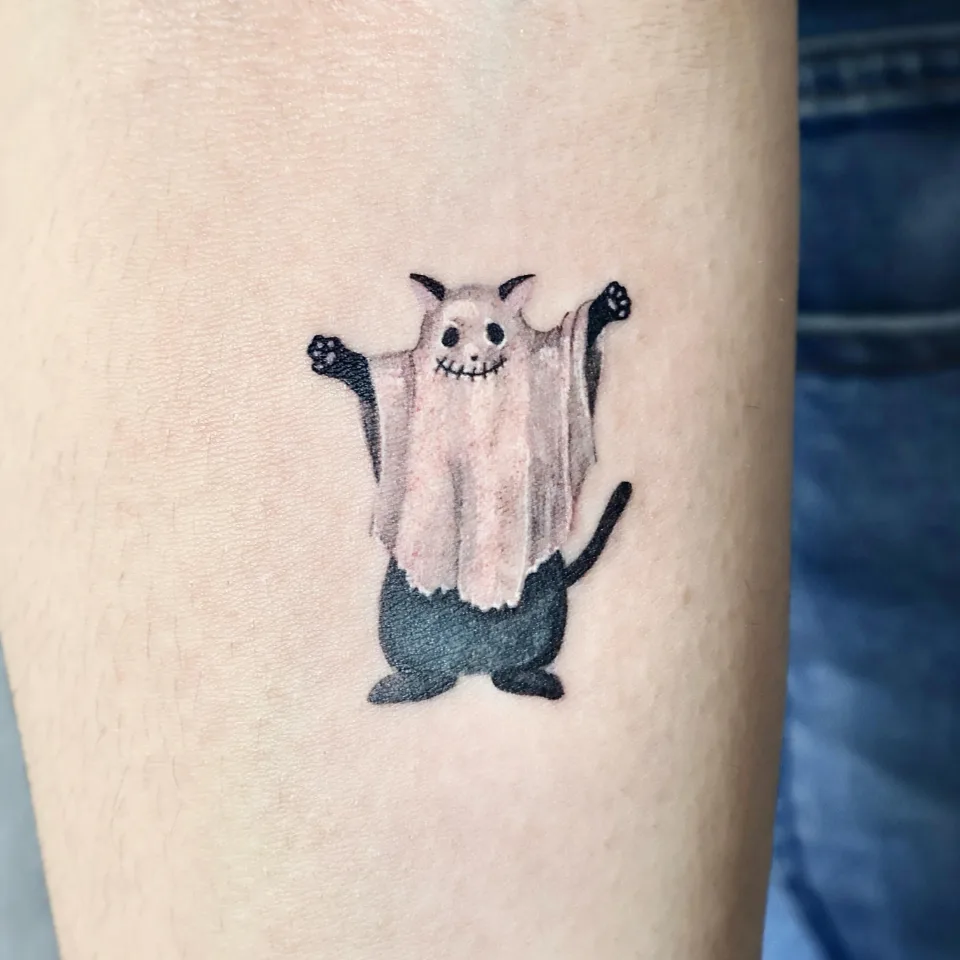
| 6 | A small character-style cat in a ghost-costume sheet with both arms spread, on a forearm | No readable English description; only hashtags for a cat tattoo and a cute tattoo |
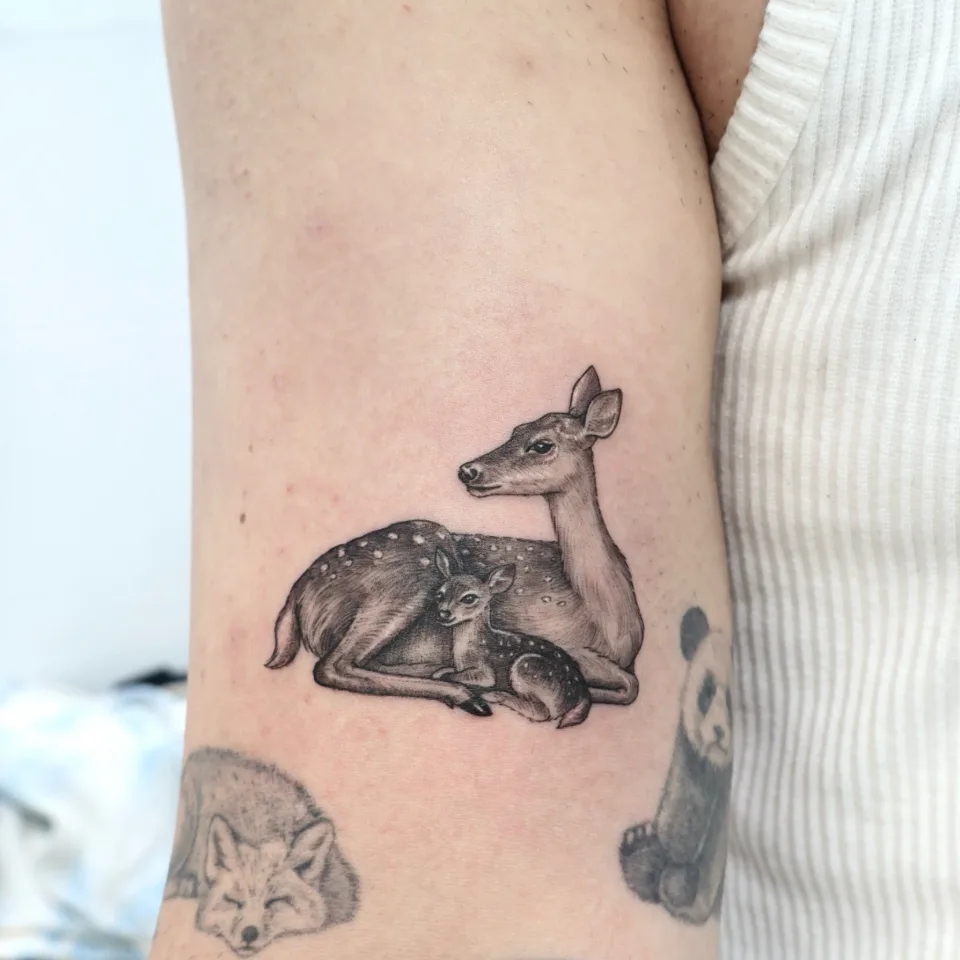
| 7 | A doe lying down with a fawn, black and grey realistic | A client gradually filling their arm with animal tattoos chose a deer and baby deer; placement and flow designed to blend with the existing tattoos |
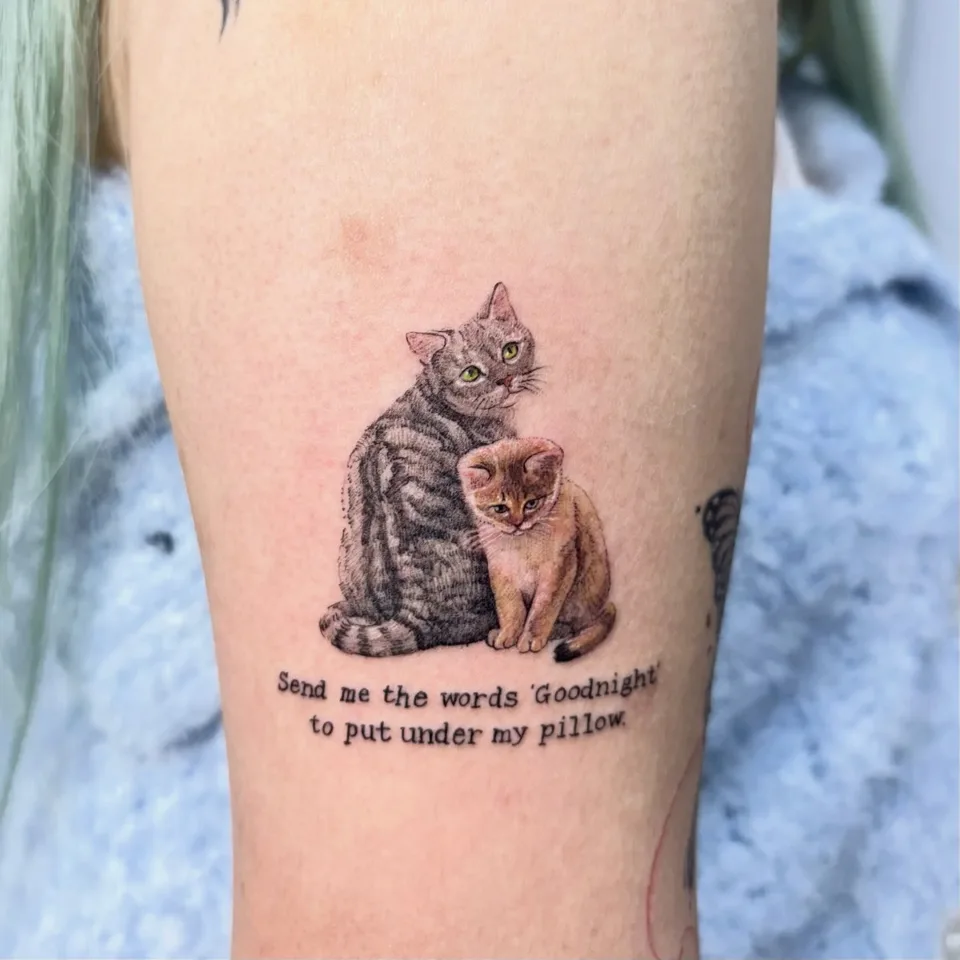
Photo 3 has the grey tabby looking back over its shoulder while the orange kitten sits in front of it looking down. The two cats are pressed together, so they read as one mass, and two lines of typewriter-style English sit below. I will not interpret the sentence.
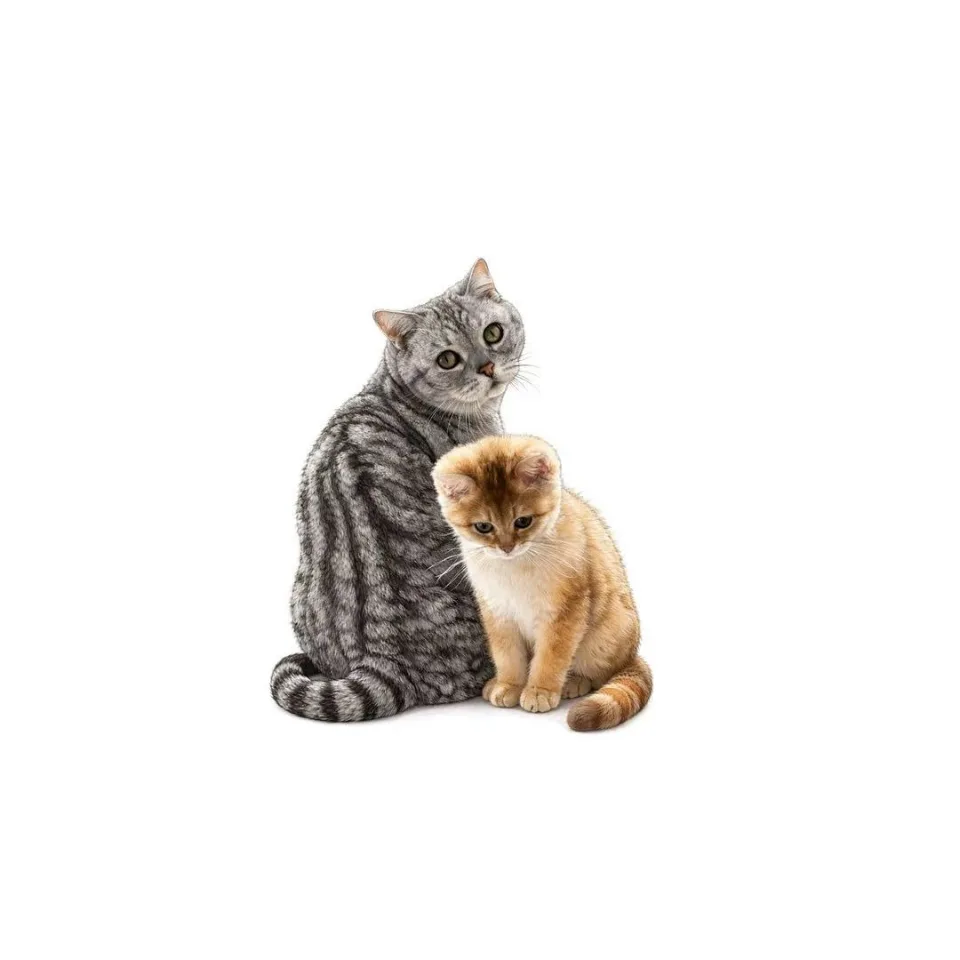
Photo 4 is not a tattoo photo. It is the second image of the same post, a picture of two cats on a white background, in the same pose and composition as the tattoo in photo 3. The post does not say whether this image was the basis of the design, so I do not claim that.
Why did these cats work so well at this size and composition?
Four decisions stand out in the photos.
- The tilt of the face: The cat in photo 1 tilts its head to one side, so the two eyes sit at different heights. One ear stands high and the other lies to the side, which gives the face more character than a straight-on view.
- A face peeking over a line: Instead of drawing the whole body, only the face peeks over a thin line, so the eyes and expression stay at the centre even at a small size.
- Fur and colour: Layers of short strokes make the green-brown stripes, with pink in the inner ears and nose tip and yellow-green eyes in contrast.
- Where the lettering sits: The small cursive word at the lower right of the line balances one side without covering the drawing. In photo 3 the two-line sentence sits in the middle below the drawing.
Photo 2 shows the same tattoo from a little farther away. Up close the eyes and fur are clear, but from a distance the silhouette of the whole face and its tilted pose come first. So it helps to picture both the close-up and the distant view when deciding face proportions.
Grouped by composition, it looks like this.
| Composition | Photos | What you can see | What to look for in reference photos |
|---|---|---|---|
| Face only | 1, 2, 5 | A face peeking over a line, a face between letters | A front-facing eye-level photo, a photo with light in the eyes |
| Body included, two cats | 3 | One cat looking back, a kitten looking down | A photo showing the whole body, the position of each cat |
| Character style | 6 | A simplified cat in a costume | One or two defining traits of that cat |
A face-only design keeps the eyes and expression alive at a small size, while including the body adds things like stripes, the tail and how two cats sit together.
Which reference photos should you prepare, and how many?
More photos is not always better; a few photos that each do a different job work best. You can start a consultation with just one.
For many people, a cat tattoo starts from time spent together, memories built up, or something only that cat has. Many people come with that kind of feeling, so I begin by asking what you'd like to keep of them. Once the posture, the stripes or the expression is clear, it's clear which photos you need.
- A front-facing face photo: taken at eye level with nothing covering the face. It is used for face proportions, the gap between the eyes, and the position of the nose and mouth.
- A photo where the fur shows clearly: sharp, in natural light. It is used for fur direction, the flow of stripes and colour.
- A photo with expression: one where the gaze, the direction of the ears and the whiskers show. As in photo 1, light visible in the eyes helps in deciding eye expression.
- A photo with the pose: one showing the whole body. It is used for how the cat sits or how two cats are arranged, as in photo 3.
Some photos are best avoided. Heavy filters can make the fur colour look different from reality, and photos taken from far away make the face too small to read the eye shape and proportions. If you only have one blurry photo, please send a few more from around the same time.
As in photo 4, a clean background makes the fur direction and the pose of two cats easy to see at a glance, and the same is worth looking for when choosing reference photos. If the cat has a habitual pose, please tell us: a favourite spot, the direction it tilts its head, or anything only you know that does not show in photos helps the design. If it is hard to explain in words, you can add a note to a photo.
Realistic, with lettering, or character style: how do you choose?
The same cat can look very different depending on how it is drawn. Photos 5, 6 and 7 are not this post's cat, but they are good for comparing directions.
Pairing with lettering is what photo 5 shows. A realistic black and grey cat face sits between cursive English letters, with a playful, tongue-out expression. The letters split on either side of the face, so face and lettering read as one mass. The post says the red lines behind are tiny scratch traces, like a memory of the cat's wild personality. It shows that if you want to include an expression or personality, combining it with lettering or lines is one way to do it.
Simplifying into a character is photo 6. A cat under a ghost-costume sheet spreads both arms in a small tattoo, with a stitched smile on the sheet and a black body and tail below. It is a cute simplification rather than a realistic depiction, so the more the form is reduced, the more important it is to pick one or two defining traits of that cat.
Black and grey realism is in photo 7. A doe lying down with a fawn is built from shading alone, capturing the fur, spots and soft texture, with a sleeping fox and a panda partly visible along the lower edge. The post says it is for someone gradually filling their arm with animal tattoos. It also says the deer held a very special meaning, connected to someone important in their life, and I will leave it at that. The placement and flow were designed to blend naturally with the existing tattoos.
- A realistic face: the iris colour and the light in the eyes matter, so a photo with sharp eyes is needed.
- A playful expression: decide on the small details that make the expression, such as the tongue or the direction of the ears.
- Character style: pick just one or two defining traits of that cat.
- Colour or black and grey: for colour, one or two photos where the fur colour is clear are a must; for black and grey, a photo showing the fur texture to build with shading helps.
If you already have tattoos, we also talk about the gap and the flow relative to them, as in photo 7. When lettering is added, we check the spelling and placement together in the consultation. If you would like to see another small design on the arm, have a look at our sword tattoo post as well.
What should you prepare before the consultation? (checklist)
You don't need much. If you jot down these seven things in your phone notes, the consultation goes much faster.
- One line on what you want to keep: a scene from your time together or something only that cat has (pose, markings, expression), in a few words.
- A front-facing face photo: taken at eye level with the face uncovered.
- A photo where the fur is clear: ideally in natural light, with the fur direction and markings visible.
- A photo with expression or pose: one or two that show a moment that feels like them.
- A photo of the area you have in mind: with your arm relaxed, and any existing tattoos included.
- Colour or black and grey: you can simply tell us the number of a photo above that you like.
- Lettering or extras to include: if you have any, tell us the spelling and placement.
Send a few reference photos from different angles rather than just one. It helps a lot in reading the eyes and fur.
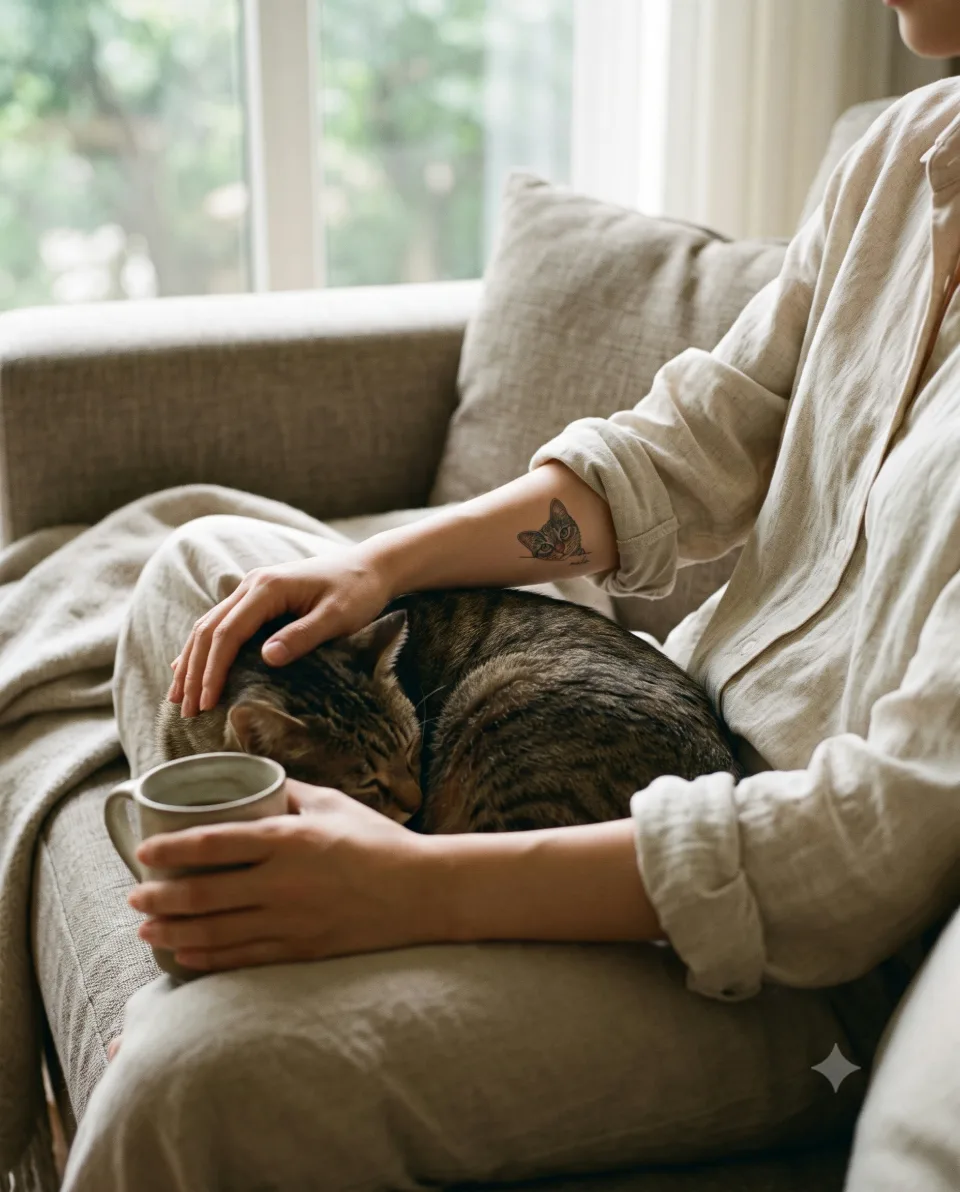
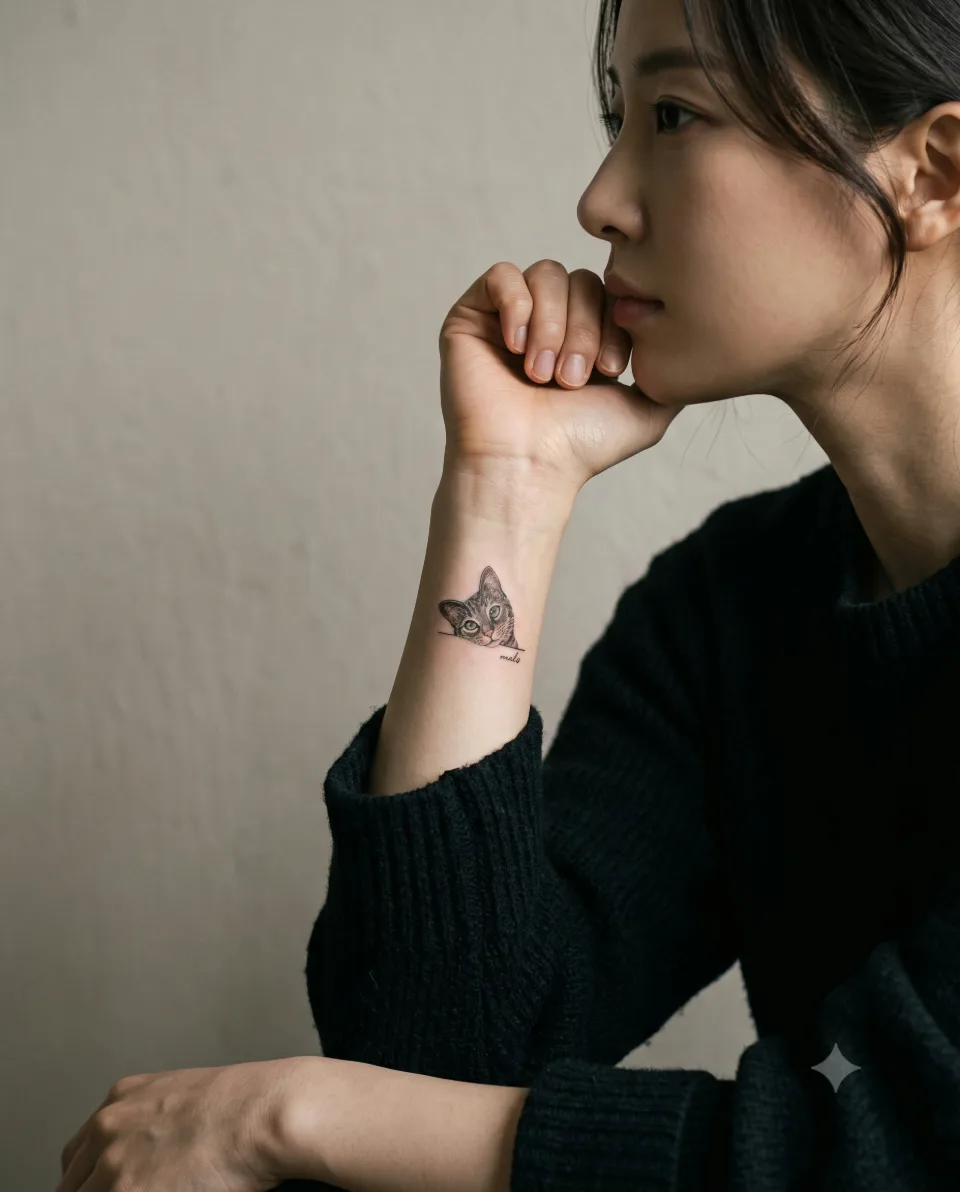
Picture how it will look in daily life too. The inner upper arm shows when you push up a sleeve, and the forearm shows as soon as you roll one back. A small cat is read at close range, with the eyes and fur, so choose the area based on your usual sleeve length and how visible you want it to be. Aftercare depends on your skin and the area, so please ask in the consultation how aftercare is explained.
How do you start a cat tattoo consultation by Instagram DM?
It's easy. Just send the following in this order.
- Open an Instagram DM to @yeonjae_tattoo. Open the Instagram DM
- Send the reference photos, a photo of the area, and one line on what you want to keep from the checklist above. Even if you can't gather everything, send what you have.
- After we see your photos, we talk through face proportions, fur, eye expression, size, layout and what is possible in an individual consultation. Price and session length are also explained then.
If choosing photos is hard, send everything you have and we will go through them together. If you want a feel for our other work, you can browse our films page, and if you are curious about starting with a small design, have a look at our mini symbol tattoo post.
Let’s talk about a tattoo that feels like you
Bring reference photos and tell us your preferred motif, size and placement.
Who is the tattoo artist behind this article?
I'm Yeonjae, a graduate of the China Academy of Art who, as of 2026, is in the eighth year of working as a tattoo artist in Hongdae. The academy is an art school founded in Hangzhou in 1928, and I bring the observation and drawing I learned there to the flow of fur, the light in the eyes and the balance of small designs.
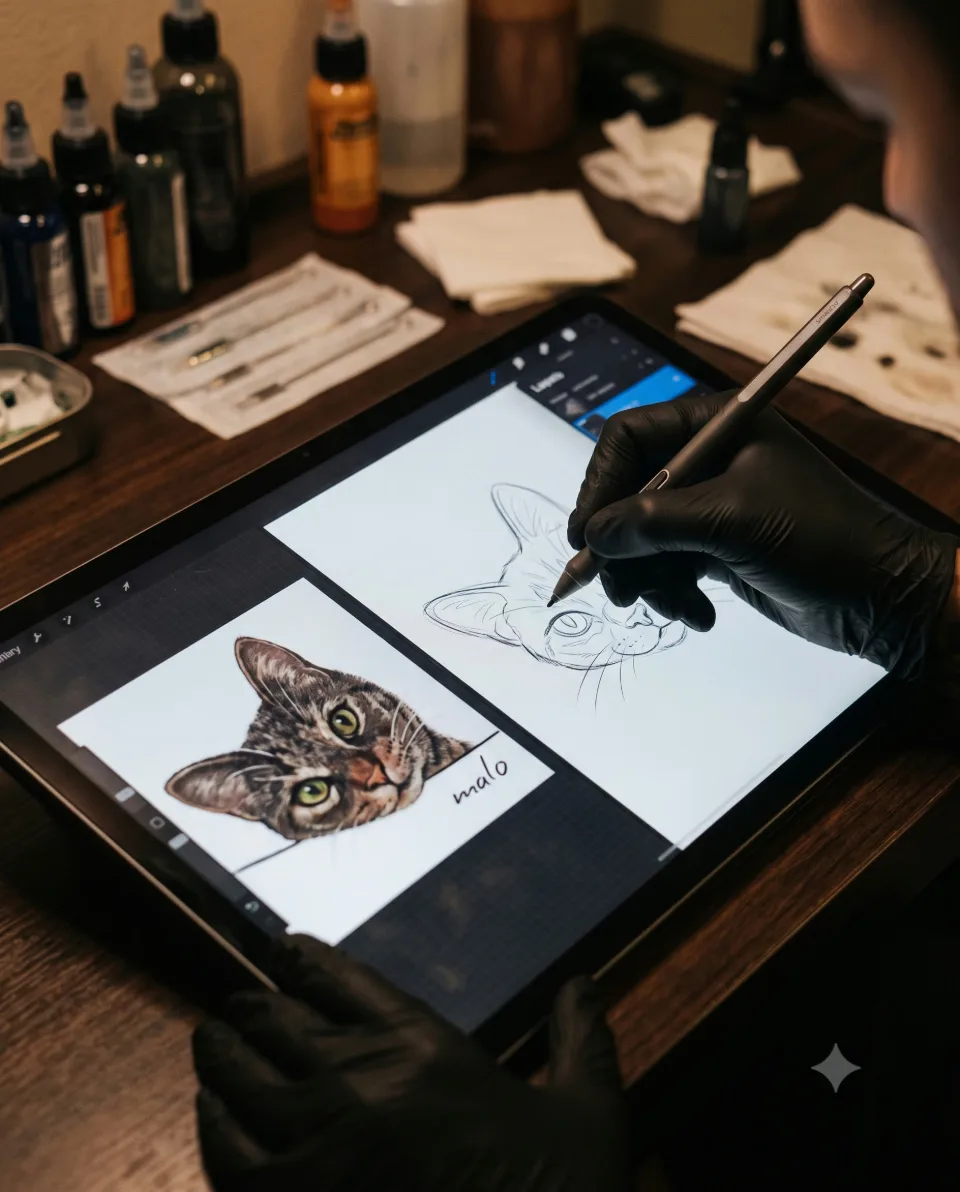
This article is based on two cat tattoo posts on the Yeonjae Tattoo Instagram account, plus photos of other pieces on the same theme that I opened and checked directly. The feelings behind the designs are limited to what the posts say, and I have not added anything about the people who received them or the meaning of the lettering. The four AI-staged images above were made to help you picture a consultation, and they are not actual tattooing scenes or real clients.
Before you book
What should I send first for a cat tattoo consultation?
Send a front-facing, eye-level face photo, a photo where the fur is clear, and a photo of the area you have in mind by Instagram DM. A photo showing that cat's own pose or expression makes it easier to shape the design.
Can I have a consultation if my photos are blurry or few?
Yes, we can start with the photos you have. If the eyes or fur are hard to see, we will tell you in the consultation which additional photos would help.
How do I choose between realistic and character style?
In the photos you can see a realistic face, a black and grey piece combined with lettering, and a simplified character-style piece. It depends on which side of the cat you want to keep, so we look at photos you like and decide in an individual consultation.
Can two cats be tattooed together?
Yes, as in photo 3, there is a piece with two cats in one design. Their positions, gaze and relative size are decided in an individual consultation after seeing the reference photos.
How can I find out about price and session length?
They depend on the size, the style of rendering and whether lettering is included, so this article does not state them. Message us on Instagram and we will go over price and session length in an individual consultation.
Key facts
- Location
- 2F, G Studio, 136-11 Eoulmadang-ro, Mapo-gu, Seoul, South Korea
- Opening hours
- Mon–Sat 11:00–23:00 · Closed on Sundays
- Artist
- Yeonjae · China Academy of Art graduate · eighth year in Hongdae (as of 2026)
- Styles
- Fine line · Floral & botanical · Cover-up
- Consultation & booking
- Confirmed after consultation via Instagram DM, LINE or KakaoTalk
- Pricing & time
- Price and session length depend on the design, size and placement, and are explained during the consultation.
China Academy of Art graduate, in her eighth year as a tattoo artist in Hongdae · as of 2026
China Academy of Art is an art university founded in Hangzhou in 1928. Its long history of art education provides context for Yeonjae’s fine-art background. About the academy · official website ↗
Yeonjae Tattoo · Blog
This post brings together the work photographs, published descriptions and guidance for preparing an inquiry. See the artist profile above for the creator’s background.
Photo source: Original artwork & context ↗
Original Instagram caption
Based on the artist’s supplied work notes. Editorial text was prepared with AI assistance.