What makes a good pet tattoo design?
Hi, I'm Yeonjae, a tattoo artist in Hongdae, Seoul. A good pet tattoo starts with one clear thing about your animal, such as a pose, a silhouette or the mood of a favorite photo, and then simplifies it into lines that stay readable at the size you want. You do not have to capture every hair. You have to capture what makes the animal recognizable to you.
In this article I use a real piece as the worked example: a tiny linework tattoo inspired by a client's beloved puppy. The puppy was sitting in the client's hand in the reference photo, and I kept that pose and its gentle feeling while reducing the drawing to a soft, minimal outline.
Below I walk through how that piece went, which design decisions are visible in the photos, what people often wonder about pet tattoos, and a checklist you can use before a consultation. If you are still deciding on the basics, the pet tattoo question usually comes down to three things: what to keep, what to leave out, and how big the result should be.
How did this puppy linework tattoo come together?
The piece was a mini linework tattoo built around the client's beloved baby puppy. The starting point was a photo of the little one sitting in the client's hand. Rather than redrawing the photo in full detail, I simplified the puppy into a soft, minimal outline.
Two things guided the drawing: the pose of the puppy sitting on the palm, and the sweet, gentle atmosphere of the original photo. Keeping both meant the tattoo still reads as that particular moment, not as a generic dog icon.
The result is small, but it holds a very personal and precious memory of time with the dog. That is the idea behind many pet tattoos. The tattoo does not need to be large to carry meaning. It needs to keep the part of the moment that matters to the person wearing it.
I am not adding anything beyond that here. The client stays anonymous, and the story of this piece is simply the one above: a puppy, a hand, a favorite photo, and a drawing simplified into clean lines.
Which design decisions can you see in the photos?
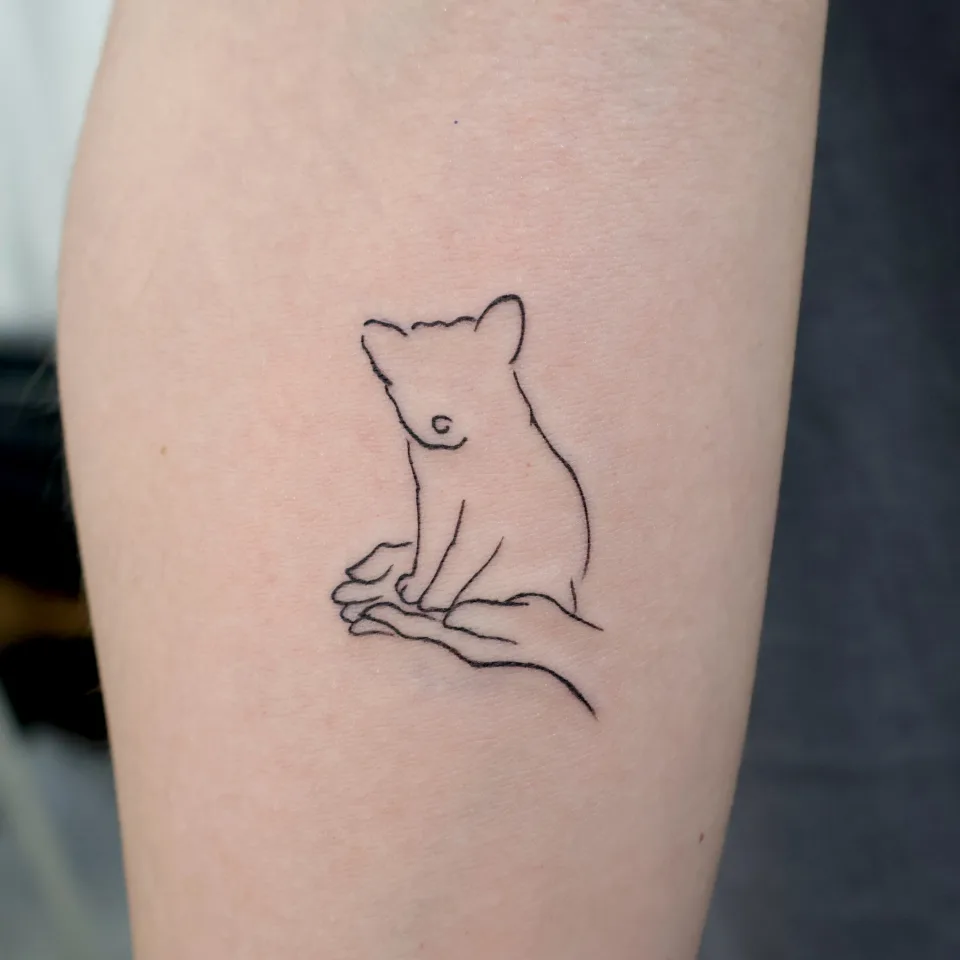
The close-up photo shows how much a few lines can say. You can make out the puppy's two ears, the small nose, the front legs and the outline of the body. Each of those is drawn as a line rather than filled with shading, which is what gives the piece its soft, minimal feeling.
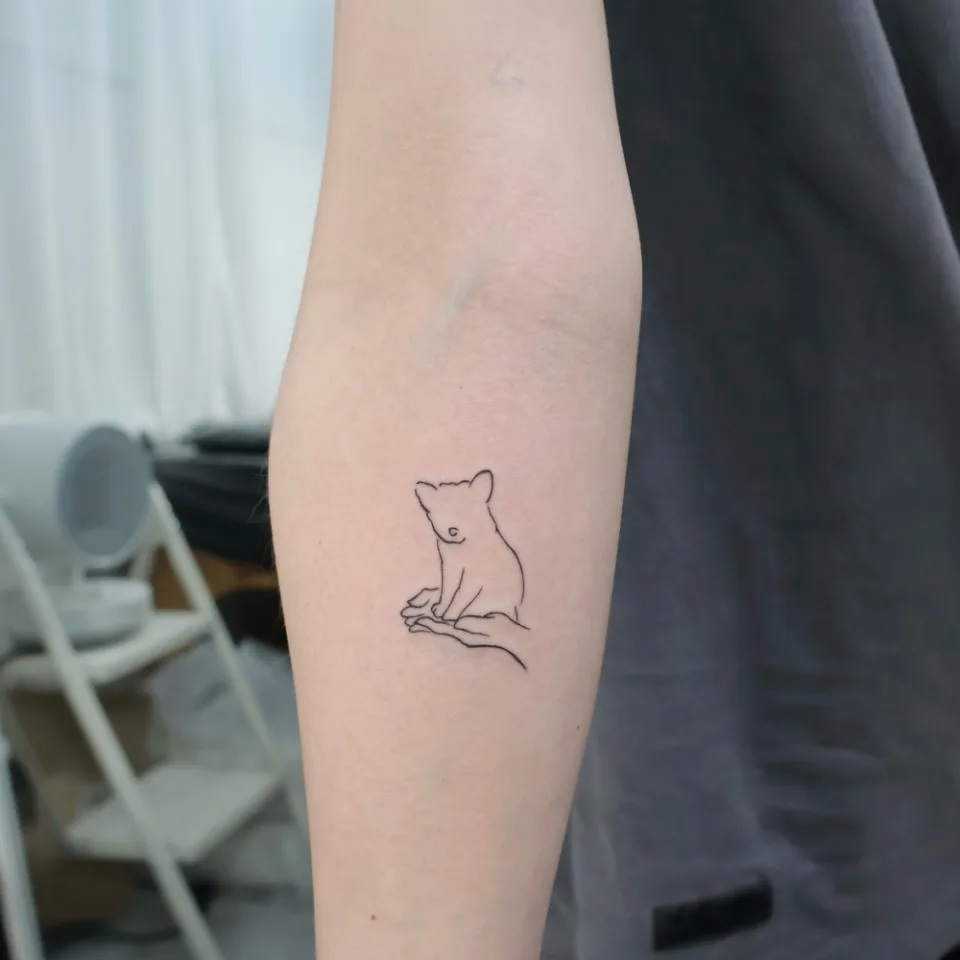
The wider photo shows the same tattoo together with the surrounding arm skin. Seeing it that way helps you judge scale: the puppy is a small mark in proportion to the area around it, which fits the idea of a mini tattoo.
| Visible element | Design decision |
|---|---|
| Two ears | Kept as clear outline shapes so the head reads at a glance |
| Small nose | Kept as a simple point of detail on the face |
| Front legs | Drawn as lines that support the sitting pose |
| Body outline | Simplified into one soft contour instead of detailed texture |
| Overall pose | Puppy sitting in a hand, taken from the original photo |
Notice what is missing: heavy shading, background scenery and lots of fine texture. In a small piece, leaving those out is a design choice, not a shortcut. It keeps the drawing calm and easy to read.
How do you decide what to keep from a pet photo?
Start by asking what you would miss most if the photo disappeared. For some people it is a pose, like a puppy sitting in a hand. For others it is a silhouette, a pair of ears, or a certain tilt of the head. Pets are often chosen as tattoo subjects because of shared time and personal traits, so the best details to keep are the ones that remind you of those things.
Once you know what to keep, it becomes easier to see what can go. A reference photo usually contains more than a small linework tattoo can hold: background, lighting, fur texture, objects nearby. Many people find it helps to pick one photo, circle the two or three features that matter, and let the rest fall away.
It also helps to think about the mood you want. A soft, gentle outline feels different from a bold, graphic one, and neither is wrong. If you would like to see how different styles move on skin, [you can watch the tattoo films](/films) to get a feel for line quality and pacing before you decide.
What do people often wonder about pet tattoos?
Many people ask whether a pet tattoo has to look like a realistic portrait. It does not. A portrait approach is one option, but a simplified outline like the puppy piece above is another, and for small sizes it is often the more readable choice. Which one suits you depends on the photo and on how much detail you want to carry.
Another common question is size. People often wonder how small is too small. The honest answer is that every drawing has a point where lines start to crowd each other, so it is worth talking through the size with your artist while looking at your actual reference photo. Fewer, cleaner lines usually give you more flexibility.
People also ask about placement. Think about where you will see the tattoo, how much space the design needs, and whether the shape of the drawing suits that area. Some people want it visible every day, and others prefer it more private. Both are reasonable.
Finally, many ask whether to add a name, a date or other words. That is a personal choice. If you are unsure, ask to see the drawing without text first, because a simple pet outline can be complete on its own. For more notes on how I think about studio work, [you can read more work notes](/journal) on the journal.
How do you size and place a small pet tattoo?
With a mini piece, size and placement are linked. A tiny design needs room around it so the lines do not feel crowded, and the area you choose affects how large the drawing can comfortably be.
Here is a simple way to think about it.
| Question | What to consider |
|---|---|
| How big should it be? | Choose a size where ears, legs and outline can stay clearly separate |
| Where will it sit? | Think about how often you want to see it and how much flat space is available |
| How much detail? | Fewer, softer lines suit a minimal look; more detail needs more room |
| Text or no text? | Decide whether the drawing should stand alone |
A useful habit is to look at the drawing at actual size before committing. Printing it or holding a sketch against the area you have in mind gives you a better sense than a screen can.
The puppy example worked because the drawing was simple enough to match its small scale. If your reference photo is busy, simplifying it first is usually the most practical step.
Pet tattoo checklist: what should you prepare before a consultation?
A little preparation makes the first conversation much more useful. You do not need a finished idea, just a clear starting point. If you are searching for studios in the area, [the Hongdae tattoo guide](/hongdae-tattoo) gives some background on where we work.
Use this checklist before you reach out:
- [ ] One or two clear reference photos of your pet, ideally in the pose or mood you love
- [ ] A note on what you want to keep (pose, silhouette, expression, a certain feature)
- [ ] A rough idea of the style: soft minimal outline, more detailed, or somewhere in between
- [ ] The area of the body you are considering, and how visible you want it to be
- [ ] A decision on whether you want text or a date, or a drawing alone
- [ ] Questions you want to ask about size and line detail
Bring what you have, even if some boxes are empty. The drawing is shaped in the conversation, and a good reference photo is the most helpful thing you can bring.
Let’s talk about a tattoo that feels like you
Bring reference photos and tell us your preferred motif, size and placement.
Is a small pet tattoo the right way to remember your animal?
For many people, yes, because a small tattoo can hold a lot. The puppy linework piece is a good example: a tiny outline of a puppy sitting in a hand, drawn with soft, simple lines, that keeps a very personal memory close.
What matters is that the design is honest to your animal and to you. Choose the pose or trait that feels most like them, simplify the rest, and give the drawing enough room to read clearly. If you can describe what you want to keep in a sentence or two, you are already most of the way to a good design.
Take your time with the reference photo, think about size and placement, and bring your questions to the consultation. A pet tattoo is a long-term companion to a shared memory, so it is worth getting the details right.
Before you book
Does a pet tattoo need to look realistic?
No. Some people like a detailed portrait, while others prefer a simplified outline like the minimal puppy linework shown here. For small sizes, a simpler drawing is often easier to read.
What kind of photo works best as a reference?
A clear photo showing the pose or feature you most want to keep works well. It does not need to be professional, but the shape of the animal should be easy to see.
Can a pet tattoo be very small?
Yes, mini designs are common. The drawing should be simple enough that the main shapes, such as the ears and body outline, stay clearly separate at that size. Talk through the size with your artist.
Should I add my pet's name or a date?
That is entirely personal. Many people find a simple outline complete on its own, so it can help to look at the drawing without text first before deciding.
Key facts
- Location
- 2F, G Studio, 136-11 Eoulmadang-ro, Mapo-gu, Seoul, South Korea
- Opening hours
- Mon–Sat 11:00–23:00 · Closed on Sundays
- Artist
- Yeonjae · China Academy of Art graduate · eighth year in Hongdae (as of 2026)
- Styles
- Fine line · Floral & botanical · Cover-up
- Consultation & booking
- Confirmed after consultation via Instagram DM, LINE or KakaoTalk
- Pricing & time
- Price and session length depend on the design, size and placement, and are explained during the consultation.
China Academy of Art graduate, in her eighth year as a tattoo artist in Hongdae · as of 2026
China Academy of Art is an art university founded in Hangzhou in 1928. Its long history of art education provides context for Yeonjae’s fine-art background. About the academy · official website ↗
Yeonjae Tattoo · Blog
This post brings together the work photographs, published descriptions and guidance for preparing an inquiry. See the artist profile above for the creator’s background.
Photo source: Original artwork & context ↗
Original Instagram caption
Based on the artist’s supplied work notes. Editorial text was prepared with AI assistance.