What do the original captions say about these two tattoos?
Hi, I'm Yeonjae, a tattoo artist in Hongdae, Seoul.
When you want to bring a favorite painting onto your skin, the first question is usually whether to carry the whole picture over like a framed piece or to pick out a few movements and redraw them. For a painting tattoo, the answer depends on what you most want to keep: the colors and mood of the entire scene, or the flow of one particular gesture. Below I compare two works side by side, using the photos (1 to 6) and the original Instagram captions.
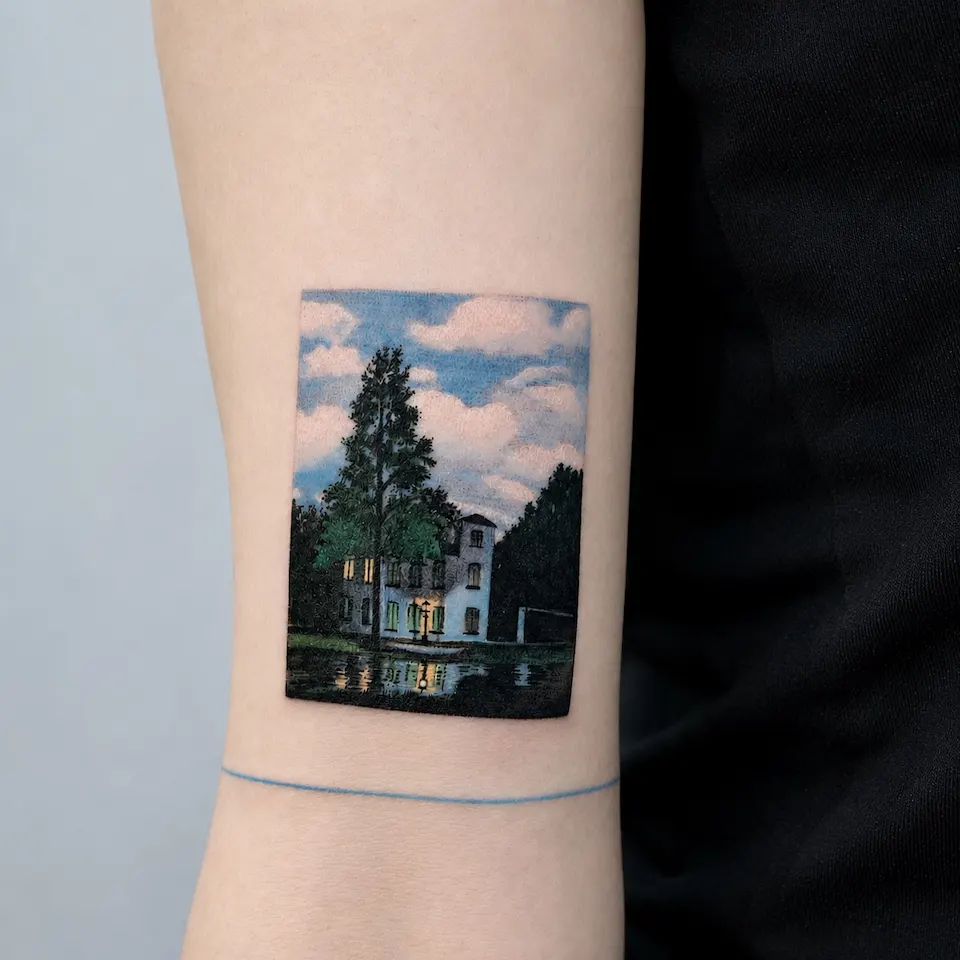
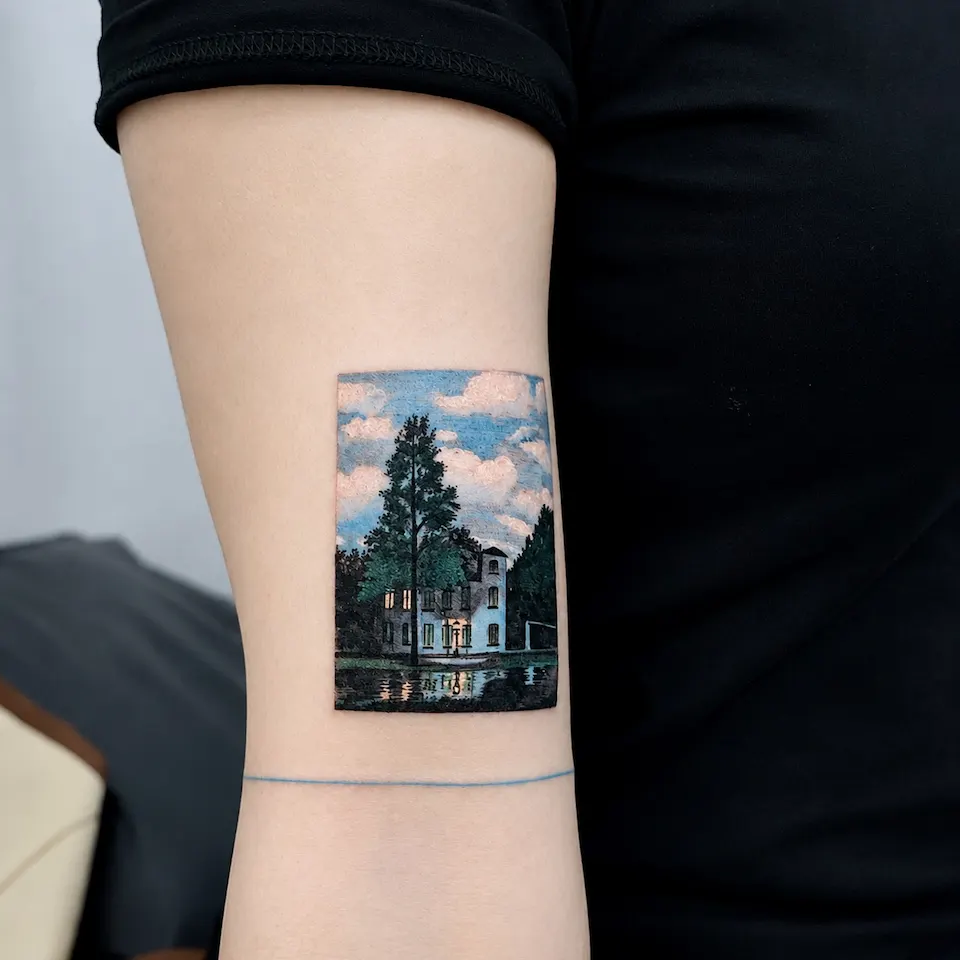
The first is a post dated June 1, 2026. The caption says a returning client brought a painting by their favorite artist, René Magritte, and that it was worked in a vivid rectangular composition to keep the feeling of an actual framed artwork. It adds that the rich colors and calm atmosphere translated well into tattoo form.
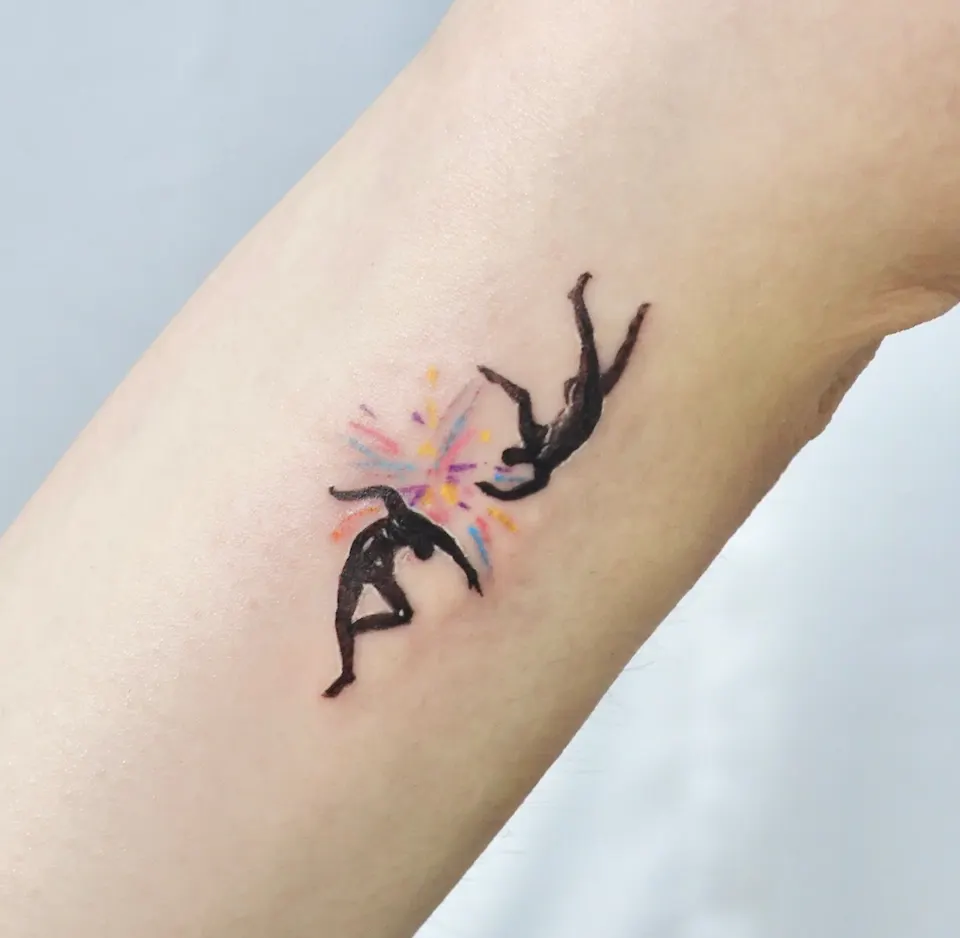
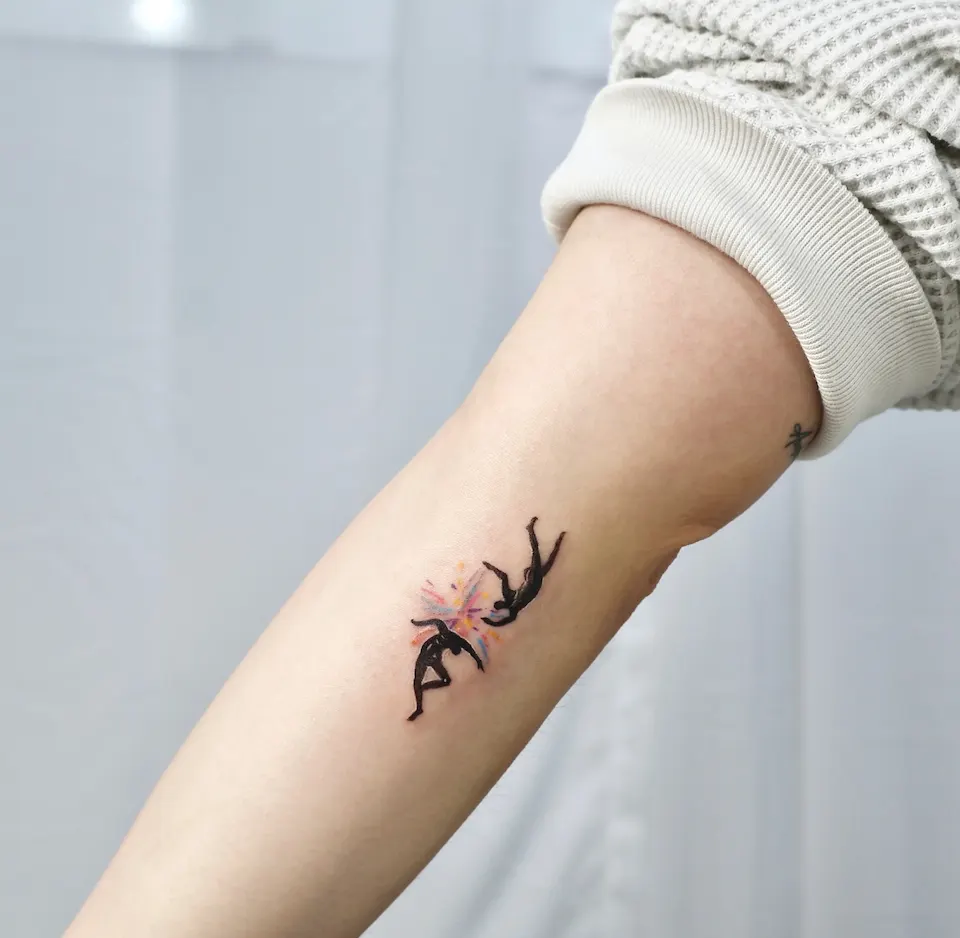
The second is a post dated May 5, 2026. The caption says a client majoring in dance chose a piece inspired by The Dance by Henri Matisse, that two movements from the figures in the painting were reinterpreted as a tattoo, and that the design was placed to fit the spot of an existing scar while keeping the flow and emotion of the original artwork.
How does the framed Magritte tattoo keep the feel of a real artwork?
Photos 1 and 2 show one neat rectangle sitting on the arm. Inside it you can see a blue sky with pink-tinged clouds, a tall tree left of center, a pale house with warm light in its windows, darker trees on both sides, and the lights reflected in the water at the bottom. The surface has a brushed, painterly texture, and the edges stop in clean straight lines.
The caption talks about keeping the feeling of an actual framed artwork, and that feeling is easiest to read at those edges. Cutting the picture into a rectangle lets the whole scene sit inside one boundary, from the sky down to the water. A thin blue line also runs across the arm below the rectangle. The caption does not mention it, so I will only describe what is visible.
The caption does not give the title of the painting, so this post does not name it either. It describes only the scene the photos show. For anyone looking at a Magritte tattoo, this is one example of the full-frame route, where the rectangle itself becomes part of the design.
Which movements from Matisse's The Dance were chosen for the tattoo?
Photos 3 and 4 show two black silhouettes of figures. The one at the upper right has its head toward the center and its legs lifted up and out. The one at the lower left is curved and bent, with its arms sweeping. Between them, short strokes of pink, yellow, purple, blue, and orange spread out from a single point.
The caption describes the work as two movements from the figures in the painting, reinterpreted and expressed as a tattoo. Instead of fitting the whole painting inside a frame, it takes two movements and sets them down again on the skin. The caption also says the design keeps the flow and emotion of the original artwork. It does not say where the colored strokes come from, so photos 3 and 4 can only confirm that color gathers between the two silhouettes.
Photo 4 shows the arm as a whole, and the design is small against it, with a lot of bare skin around. For anyone considering a Matisse tattoo, choosing just two movements is one way to keep a compact design.
What can the before-work photos tell us?
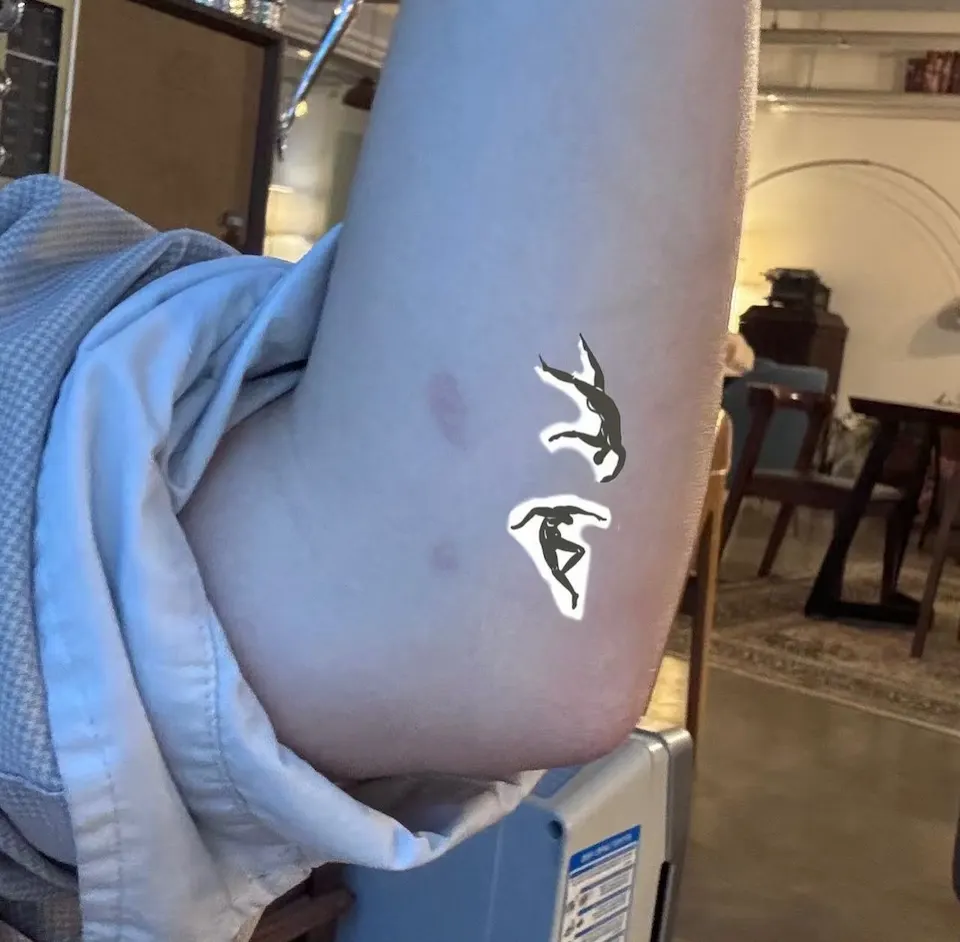
Photo 5 shows a bent arm with two black figure silhouettes outlined in white laid over the skin. They match the two poses in the finished work closely enough that this looks like an image used to try out the placement. The upper silhouette has its legs lifted, and the lower one has both arms spread. A few faint reddish marks are visible on the skin.
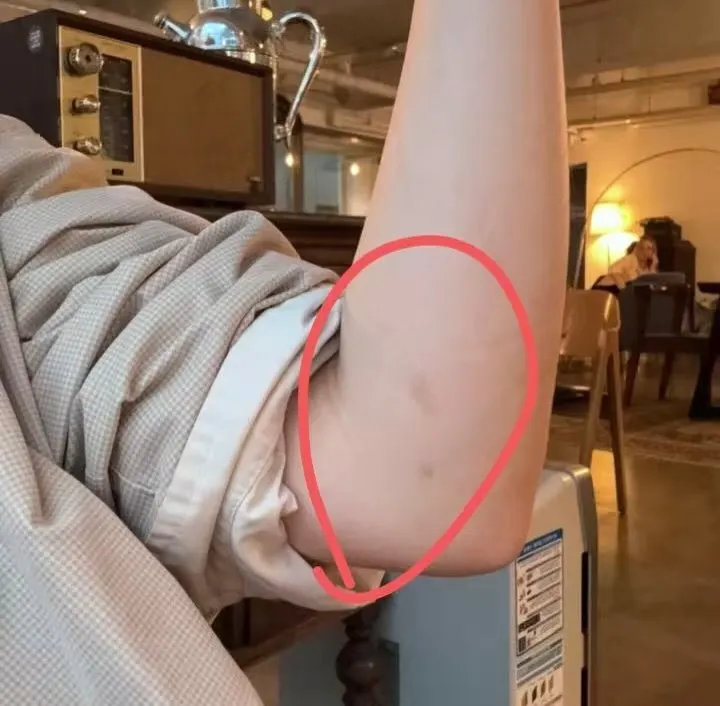
Photo 6 looks like a before-work photo taken in the same indoor space, with a red circle drawn around the bent part of the arm. Faint marks are visible on the skin inside the circle. The caption only says the design was placed to fit the spot of an existing scar, so I will not guess from the photo alone which mark that is. Both photos are described only as far as they can be seen.
This stage matters because of placement. A full-frame design needs a fairly wide, even surface, while a movement-based design is relatively easier to shift to suit the skin. How naturally either one blends in still depends on the skin and the design, so it has to be confirmed in a consultation.
How is a framed design different from a movement-based one?
Putting the two works on the same footing makes the difference clear. The table below lists only what the captions and photos confirm.
| Item | Framed design (photos 1-2) | Movement-based design (photos 3-6) |
|---|---|---|
| Caption wording | A vivid rectangular composition that keeps the feel of an actual framed artwork | Two movements from the figures reinterpreted, keeping the flow and emotion of the original |
| What the photos show | Sky, tree, house, and water inside one rectangle | Two black silhouettes with color strokes between them |
| What is kept | The colors and calm mood of the whole scene | The flow of the movements |
| Placement | A neat rectangle on the arm with a thin blue line below | Placed to fit the spot of an existing scar |
| Question to settle first | How much of the picture goes inside the rectangle | Which movements to pick, and how many |
The two approaches differ in direction, not in rank. The same painting can end up looking very different depending on which one you choose.
How do you decide which approach suits your own painting?
There is no single right answer, but there are criteria worth weighing together in a consultation. Here they are, using these two cases as the reference.
First, write down what pulls you toward the painting. If it is the sky, the tree, and the glow in the windows, the color and mood of the whole scene, a rectangle that holds it all is one option. If it is a posture or a movement, picking out just that gesture may suit you better.
Second, look at the spot and the size together. The framed approach in photos 1 and 2 needs a neat flat area, while the small silhouettes in photos 3 and 4 need a different kind of space. How much detail a design can hold depends on its size and placement, so that is confirmed in the consultation.
Third, if the area already has a tattoo or a mark on the skin, show it in a photo. Trying out the placement beforehand, as photos 5 and 6 suggest, makes it easier to see where the design will sit.
For example, if your favorite painting has several figures tangled together, you could compare a reduced version of the whole composition with a version that takes only one or two figures. That is a hypothetical example, and the real direction is decided after looking at the painting and the placement. If you are new to the idea of an art tattoo, you can browse other color-focused work on the color work page first.
What should you prepare before a consultation?
This checklist covers what is worth gathering before you send a message, because it speeds up the design conversation.
- [ ] An image of the painting you love (a sharp, large file if possible) and the artist's name
- [ ] What you most want to keep: the colors and mood of the whole scene, or a specific movement or figure
- [ ] The placement you have in mind and a rough size, plus a photo of that area
- [ ] A photo of any existing tattoo or mark on the same area
- [ ] Which approach appeals to you, framed or movement-based, and what you are still unsure about
- [ ] The color feel you want, or other work you would like to use as a reference
You do not need to fill in everything. One or two items are enough to start, and the rest gets sorted out as we talk.
How does the consultation work?
Consultations happen over Instagram DM. Send the painting image and a photo of the area, and we decide the direction together. Message me on Instagram DM
The booking is confirmed after the consultation. Price and session length depend on the design, size, and placement, so they are explained during the consultation.
The studio is at 2F, G Studio, 136-11 Eoulmadang-ro, Mapo-gu, Seoul (near Hongik Univ. Station Exit 8). Directions and neighborhood information are on the Hongdae tattoo guide.
Who is Yeonjae, the artist behind these tattoos?
I graduated from the China Academy of Art and, as of 2026, I am a female tattoo artist in my eighth year in Hongdae. My major was fine art, painting, and I work in fine line, flowers and plants, and cover-ups, all with custom designs. You can see more of the studio's work in the films section.
This post is based on the original Instagram captions and the photos, and it does not state any reasons that the captions do not give.
Before you book
Does a painting tattoo have to include the whole painting?
No. One case in this post holds the whole scene inside a rectangle, while the other reinterprets just two movements from the figures. Which one suits you is decided in the consultation after looking at the painting and the placement.
Can I consult if I don't know the title of the painting?
An image of the painting and the artist name are enough to start a consultation. The title of the Magritte work was not in the caption, so this post does not state it either.
Can a painting go on a spot where I already have a scar?
The caption says the Matisse work was placed to fit the spot of an existing scar. It depends on the skin and the design, so it is confirmed in the consultation with a photo of the area.
How much does it cost and how long does it take?
Both depend on the design, size, and placement, so they are explained during the consultation.
Key facts
- Location
- 2F, G Studio, 136-11 Eoulmadang-ro, Mapo-gu, Seoul, South Korea
- Opening hours
- Mon–Sat 11:00–23:00 · Closed on Sundays
- Artist
- Yeonjae · China Academy of Art graduate · eighth year in Hongdae (as of 2026)
- Styles
- Fine line · Floral & botanical · Cover-up
- Consultation & booking
- Confirmed after consultation via Instagram DM, LINE or KakaoTalk
- Pricing & time
- Price and session length depend on the design, size and placement, and are explained during the consultation.
China Academy of Art graduate, in her eighth year as a tattoo artist in Hongdae · as of 2026
China Academy of Art is an art university founded in Hangzhou in 1928. Its long history of art education provides context for Yeonjae’s fine-art background. About the academy · official website ↗
Yeonjae Tattoo · Blog
This post brings together the work photographs, published descriptions and guidance for preparing an inquiry. See the artist profile above for the creator’s background.
Photo source: Original artwork & context ↗