What should you check first when choosing back tattoo size and placement?
Hi, I'm Yeonjae, a tattoo artist in Hongdae, Seoul. If you are planning a back tattoo, the short answer is to decide size and placement together rather than one after the other. Each one limits what the other can do, so a number like "15 cm" only makes sense once you know where on the back it will sit.
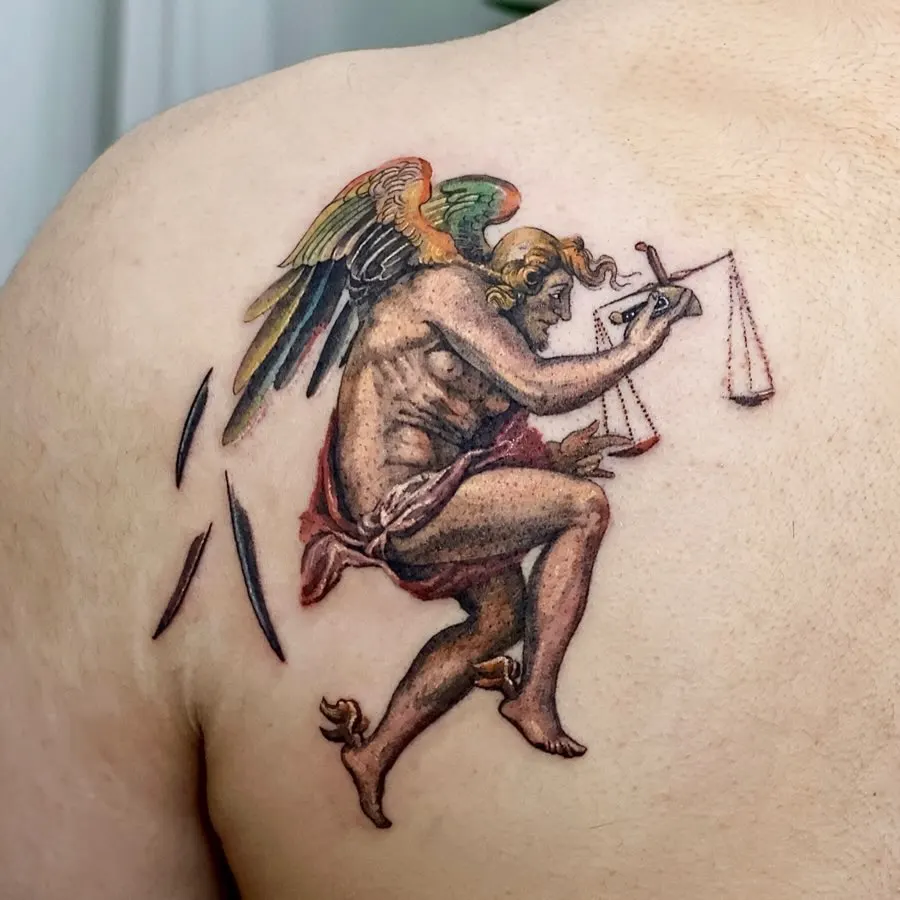
A good example is the Kairos piece I'll walk through below. It was done at 15 cm on the shoulder side of the back, and that one measurement plus one area already says a lot about the design. Seeing how those two choices fit together is the quickest way to understand your own.
In this article I'll retell how that piece went, then go through what size and placement mean for a back tattoo in general. After that I'll cover questions people often ask and finish with a checklist you can bring to a consultation. Everything specific to the Kairos piece comes from the notes on that one work. Everything else is general guidance, not a promise about any particular result.
The back is a wide area, and that is exactly why it feels hard to decide. Having room does not mean you have to use all of it. If you are still choosing where to get tattooed in Seoul, our [Hongdae tattoo guide](/hongdae-tattoo) may be a useful companion to this article.
How did the Kairos back tattoo go?
The piece is called Kairos, and I tattooed it at 15 cm on the shoulder side of the back. That is the whole of what I recorded about this session, and I'd rather tell you that plainly than fill the gap with a made-up story. I was glad the client chose to come to the studio, and I said thank you at the end.
The caption that went with the photo tags the piece in a few ways. It mentions Roman mythology, the god of opportunity, a meaningful tattoo and an oil-painting style. It also uses Hongdae and back tattoo tags. Those tags tell us the theme and the style direction, but the caption does not say why the client chose this subject, so I won't guess at a reason.
What we can learn from the record is practical. A defined size (15 cm) and a defined area (the shoulder side of the back) were settled for a single motif. That pairing is exactly what I suggest you aim for before your own session: one subject, one size, one area.
What does 15 cm on the shoulder side of the back tell you?
Putting the facts of this piece side by side makes the design decisions easier to see. Here is what the record states.
| Item | Point |
|---|---|
| Subject | Kairos, tagged in the caption as the god of opportunity from Roman mythology |
| Size | 15 cm |
| Placement | Shoulder side of the back |
| Style tag | Oil-painting style, as tagged in the caption |
A size stated in centimeters is more useful than "small" or "medium", because everyone pictures those words differently. When you talk to an artist, a measurement lets both of you look at the same thing. It also lets you hold a ruler or a paper template against your own body and judge the scale for yourself.
The shoulder side of the back is an area many people think about because it sits near the edge of the back, where the surface turns toward the arm. In general, that means the design should be planned with the curve and the movement of the shoulder in mind. I won't make claims about how this particular piece looks in motion, but this is the kind of question worth raising in a consultation.
How do you choose the right size for a back tattoo?
Start from the subject, not from the empty space. A single motif with a clear focal point usually asks for a size where its main features can be read at a glance. A larger scale gives more room for fine detail, and a smaller scale asks for a simpler treatment.
Then think about how the piece will relate to the rest of your back. A 15 cm design leaves a lot of untouched skin around it, which keeps the option of adding something later, or of leaving it alone as a single standalone piece. Neither choice is better. What matters is that you decide on purpose, so the tattoo does not feel accidentally small or accidentally crowded.
A helpful habit is to cut a paper shape at the size you are considering and look at it in a mirror from a few angles. Take photos of it, and look again after a day or two. If you still like the scale after that, you have a much firmer basis for the conversation with your artist.
How do you choose the right placement on the back?
Placement is partly about looks and partly about daily life. Ask yourself who will see the tattoo and when. A spot near the shoulder may show with some necklines and not with others, while the middle of the back is usually covered most of the time. There is no right answer, only the one that matches how you want to live with the piece.
It also helps to remember that you cannot easily see your own back. Many people find that the most important viewer of a back tattoo is someone else, or a mirror and a phone camera. If being able to see it yourself matters to you, say so early, because it can change the area you choose.
Finally, think about posture. The back changes shape when you stand, sit, reach or turn, and the shoulder area changes the most. Bringing a photo of yourself standing naturally, from behind, can help an artist plan how the design will sit across those shapes. For more examples of how placement looks in real work, you can [read more work notes](/journal) on the studio journal.
What do people often wonder about back tattoos with a meaning?
Many people ask whether a meaningful theme, such as a myth or a symbol, should change the size. The honest answer is that meaning guides what you include, and size decides how clearly it can be shown. If a figure or symbol matters to you, give it enough room to be recognized, and let any supporting elements stay simple.
Another common question is whether a meaning has to be explained to everyone who sees the tattoo. It does not. Some people like a design that is clearly readable, and others prefer one that keeps its meaning private. Deciding which of the two you want will also help you choose a size and an area.
People also ask whether the style matters as much as the subject. In practice, the two are linked. The Kairos piece, for example, was tagged as oil-painting style, and a painterly look is a style choice to talk through with your artist alongside scale and placement. Bring references you like, and describe what you like about them in your own words.
If you would like to see how tattoo work is shown in motion, you can also [watch the tattoo films](/films) the studio shares.
Checklist: what should you prepare before a back tattoo consultation?
Coming in with a few decisions already made makes the consultation shorter and clearer. You do not need every answer, but the more of these you have considered, the easier it is to shape a design that suits you. Use this list as a starting point.
- [ ] I know the subject or theme I want, and I can say it in one sentence.
- [ ] I have a size in centimeters in mind, and I have checked it with a paper template.
- [ ] I have picked a rough area of the back, such as the shoulder side, the upper back or the center.
- [ ] I know who will see the tattoo and when, and whether that matters to me.
- [ ] I have two or three reference images and can explain what I like in each.
- [ ] I have a photo of my back, taken while standing naturally, to show the area.
- [ ] I have written down my questions about style, detail and anything I am unsure about.
If you can tick most of these, you are well prepared. If you can tick only a few, that is perfectly fine too, because talking it through is what the consultation is for. Bring what you have, and we will work out the rest together.
Let’s talk about a tattoo that feels like you
Bring reference photos and tell us your preferred motif, size and placement.
Before you book
Is a 15 cm tattoo a good size for the back?
It depends on the subject and how much space you want around it. A 15 cm piece, like the Kairos tattoo on the shoulder side of the back, leaves plenty of open skin and suits a single motif. Check the scale with a paper template before you decide.
Should I choose size or placement first?
Decide them together. The area you pick limits how large the design can comfortably be, and the size you want may change which area works. Talking about both in the same consultation avoids surprises.
Does a meaningful tattoo need to be bigger?
Not necessarily. Meaning decides what you include, while size decides how clearly it can be read. A simple, clear design can carry a lot of meaning at a modest scale.
What should I bring to a back tattoo consultation?
Bring a clear idea of the subject, a size in centimeters, a rough area, a few reference images and a photo of your back standing naturally. A list of your questions helps too.
Can I add more to my back later?
Many people leave space around a first piece so they can decide later. If you might want to add something, mention it at the consultation so the first design is planned with that in mind.
Key facts
- Location
- 2F, G Studio, 136-11 Eoulmadang-ro, Mapo-gu, Seoul, South Korea
- Opening hours
- Mon–Sat 11:00–23:00 · Closed on Sundays
- Artist
- Yeonjae · China Academy of Art graduate · eighth year in Hongdae (as of 2026)
- Styles
- Fine line · Floral & botanical · Cover-up
- Consultation & booking
- Confirmed after consultation via Instagram DM, LINE or KakaoTalk
- Pricing & time
- Price and session length depend on the design, size and placement, and are explained during the consultation.
China Academy of Art graduate · eighth year as a tattoo artist in Hongdae · as of 2026
China Academy of Art is an art university founded in Hangzhou in 1928. Its long history of art education provides context for Yeonjae’s fine-art background. About the academy · official website ↗
Yeonjae Tattoo · Blog
Photos in this post: 1 real work photo
This post brings together the work photographs, published descriptions and guidance for preparing an inquiry. See the artist profile above for the creator’s background.
Original Instagram caption
Based on the artist’s supplied work notes. Editorial text was prepared with AI assistance.