What should you prepare before a first consultation with a female tattoo artist in Hongdae?
Hi, I'm Yeonjae, a tattoo artist in Hongdae, Seoul. If you are searching for a female tattoo artist in Hongdae and wondering how to get ready for a first consultation, the short answer is this: bring a clear idea of what you want, photos of any tattoos you already have, a rough sense of placement, and a few questions. You do not need a finished design. A consultation is where an idea becomes a plan.
This guide is built around one real piece of work: an existing cherry blossom tattoo that was reworked into Mugunghwa, Korea's national flower. A rework is a good example because it shows how many decisions sit behind a single tattoo. Placement, line flow, shading and how the new work meets the tattoos around it all had to be considered together.
If you are still choosing a studio area, the [Hongdae tattoo guide](/hongdae-tattoo) gives some background on the neighborhood. Below, I walk through the case, the design choices you can see in the photos, what people commonly wonder, and a checklist you can copy before you book.
Here is a quick overview of what to prepare:
| Item | Why it helps |
|---|---|
| Reference images | Shows the mood, shapes and style you like |
| Photos of existing tattoos | Lets the design be planned around what is already there |
| Placement idea | Shapes the size and the flow of the composition |
| What to keep or change | Keeps the conversation focused |
| Your questions | Makes sure nothing is left unasked |
How did the cherry blossom to Mugunghwa rework go?
The starting point was a cherry blossom tattoo that already existed on the arm. It was reworked into the Mugunghwa, Korea's national flower. The goal was not to simply cover the old design with a new one.
Instead, I adjusted the petal shapes, the flow of the lines and the shading one by one, so that the character of the Mugunghwa would come through. It was a careful touch-up rather than a cover-up in the usual sense.
The flowers also needed to sit comfortably among the tattoos already around them. So the branches, the leaves and the overall flow were connected in a natural way, which keeps the new flowers from looking separate from the rest of the arm.
The composition was gently extended and refined to link the existing pieces more smoothly. The result is a softer and more balanced flow across the arm. The original placement and its traces were kept, while the tattoo took on a completely new character.
What design decisions can you see in the photos?
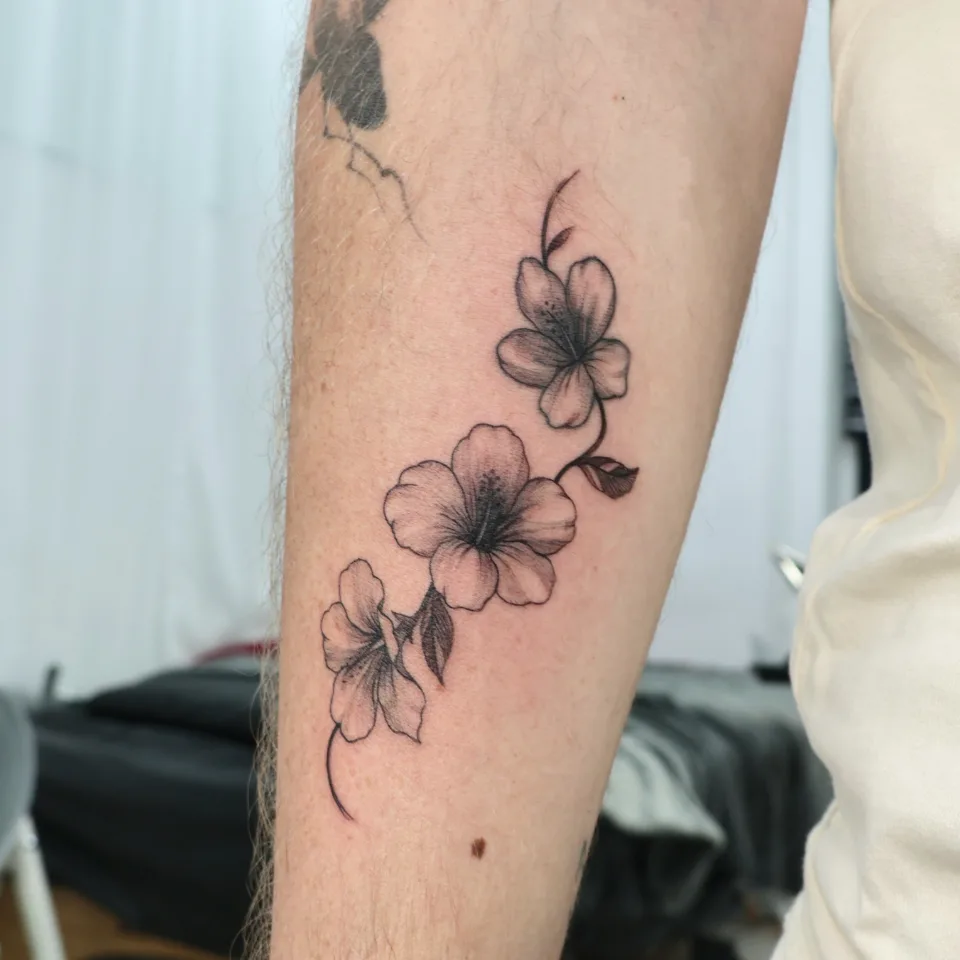
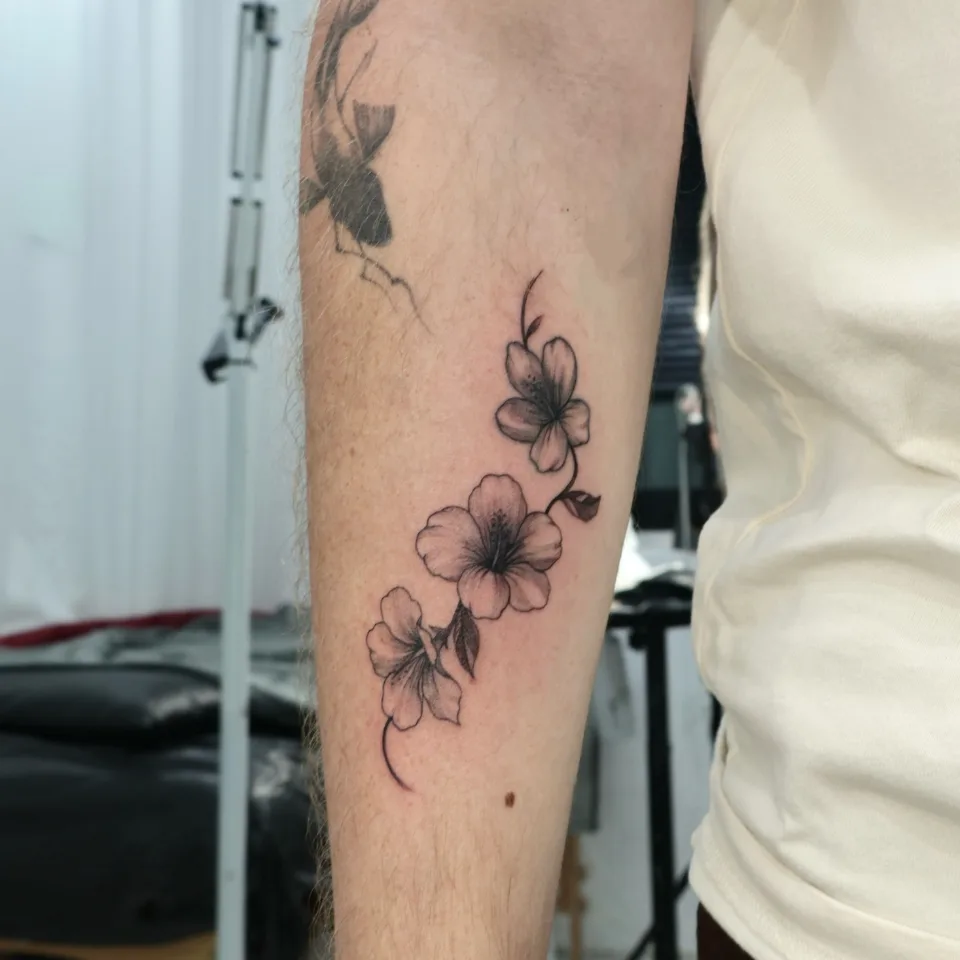
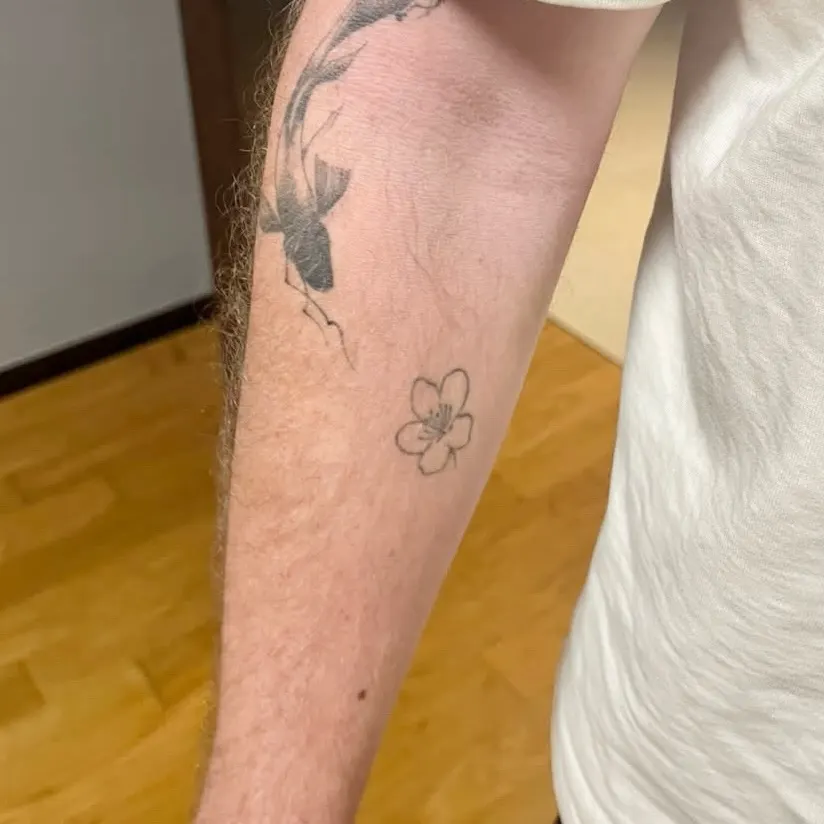
The finished photos show the old cherry blossom reshaped into three Mugunghwa flowers with a branch. The before photo shows only a small flower outline left on the arm, with an existing tattoo above it. Comparing the two makes it clear that the work started from what was already on the skin rather than from a blank page.
Three choices stand out. First, placement was kept: the new flowers occupy the same spot as the old blossom. Second, the flowers were reshaped through petal form, line flow and shading. Third, the surroundings were connected with branches and leaves, so the flowers read as part of one arm composition.
The second finished photo shows the Mugunghwa together with the existing tattoo higher up on the arm. That view is useful because it shows how a new element can relate to older work. Seeing your own tattoos together in one photo is exactly the kind of material worth bringing to a consultation.
You can find more notes on finished pieces in the [work notes](/journal), which can help you build a sense of what details to look at in your own references.
What do people often wonder before a first consultation?
Many people ask whether they need a finished design before they walk in. Usually they do not. A few reference images and a clear sense of what you like and dislike are often enough to begin a conversation.
Another common question is how to talk about a tattoo you already have and no longer feel the same about. The rework above shows one approach: decide what you want to keep, such as the placement, and what you want to change, such as the shapes and the character of the piece. Saying this out loud makes the discussion much more concrete.
People also wonder whether a tattoo should match the ones around it. There is no single rule. In this case, the branches, leaves and overall flow were used to connect the new flowers with their surroundings, but your own piece might call for a different answer.
Here is how common questions map to what to prepare:
| Common question | What to bring or decide |
|---|---|
| Do I need a finished design? | A few references and a few words about the mood |
| Can an old tattoo be changed? | Clear photos of it and a note on what you want to keep |
| Should it fit my other tattoos? | Photos of the whole area, not just one spot |
| How do I choose placement? | A rough idea of where, plus how visible you want it |
How do you choose the right size and placement?
Size and placement are linked. A small flower and a larger branch composition behave differently on the same area, so it helps to decide roughly where you want the tattoo before settling on how big it should be. Placement also affects how the lines flow around the body.
If you already have tattoos nearby, look at how they sit together. In the Mugunghwa piece, the existing placement was respected and the composition was extended to connect with its neighbors. That is a good reminder that the space around a tattoo matters as much as the tattoo itself.
It also helps to think about how the tattoo will be seen in daily life. Some people like a design that is visible at a glance, while others prefer something quieter. Neither is wrong, but naming your preference early makes the planning easier.
Bring photos of the area from a few angles, taken in natural light if you can. They give a clearer picture than a description, and they make it easier to talk about how the design could follow the shape of the arm or another area.
What is the checklist to bring to your first consultation?
Use this checklist as a simple way to organize your thoughts before you meet. You do not have to complete every item, but the more you can answer, the smoother the conversation tends to be.
- [ ] Two to five reference images that show the mood, line style or shapes you like
- [ ] Clear photos of any existing tattoos or the area you are considering
- [ ] A rough idea of placement and whether you want it visible or discreet
- [ ] Notes on what you want to keep and what you want to change, if it is a rework
- [ ] A few words or a meaning you want the design to carry, if it has one
- [ ] A list of questions you want to ask
- [ ] Your preferred timing and any scheduling limits
If your tattoo has a meaning, such as a flower or a symbol, think about how that meaning could show up in concrete choices. That might be the type of flower, the number of blooms, the branch or the amount of detail. Meaning becomes much easier to design once it is tied to visible decisions.
When your notes are ready, you can send them through the consultation link on this page and we can talk through the details from there.
Let’s talk about a tattoo that feels like you
Bring reference photos and tell us your preferred motif, size and placement.
What should you remember when reworking an existing tattoo?
A rework starts from what is already on your skin, so the first step is to look at it honestly. Which parts do you still like, and which parts feel off? In the Mugunghwa case, the placement and traces of the old tattoo were kept, while the flower character was completely changed.
It is also worth knowing that a rework is a design conversation, not a single fixed method. Petal shapes, line direction, shading and the connection to nearby tattoos can all be adjusted, but what is possible depends on the existing work and what you hope to see. That is why clear photos matter so much.
If you like seeing how pieces come together, the [tattoo films](/films) offer another way to get a feel for the work before you decide. Seeing a few examples can help you describe what you want in your own words.
Finally, take your time. A first consultation is a chance to ask questions and see whether the approach feels right for you. Coming in with a short list of notes is usually the best way to make that conversation useful.
Before you book
Do I need a finished design for my first consultation?
Not necessarily. A few reference images, photos of the area and a short description of what you like are usually enough to start. The design can be shaped during the conversation.
Can I ask about changing a tattoo I already have?
Yes, and it helps to bring clear photos of it. Tell the artist what you want to keep, such as the placement, and what you want to change. The cherry blossom to Mugunghwa piece in this article is one example of that approach.
Why bring photos of my existing tattoos?
A new design is easier to plan when it can be seen next to what is already there. Photos of the whole area show how the flow, lines and spacing might connect.
How can I explain a meaning I want in my tattoo?
Try tying the meaning to something visible, like the type of flower, the number of blooms, the branch or the level of detail. Concrete choices are easier to design than a general feeling.
What questions are useful to ask in a first consultation?
Many people ask about placement, size, how the design will relate to existing tattoos, and how the process will work. Writing your questions down beforehand helps you cover everything.
Key facts
- Location
- 2F, G Studio, 136-11 Eoulmadang-ro, Mapo-gu, Seoul, South Korea
- Opening hours
- Mon–Sat 11:00–23:00 · Closed on Sundays
- Artist
- Yeonjae · China Academy of Art graduate · eighth year in Hongdae (as of 2026)
- Styles
- Fine line · Floral & botanical · Cover-up
- Consultation & booking
- Confirmed after consultation via Instagram DM, LINE or KakaoTalk
- Pricing & time
- Price and session length depend on the design, size and placement, and are explained during the consultation.
China Academy of Art graduate, in her eighth year as a tattoo artist in Hongdae · as of 2026
China Academy of Art is an art university founded in Hangzhou in 1928. Its long history of art education provides context for Yeonjae’s fine-art background. About the academy · official website ↗
Yeonjae Tattoo · Blog
This post brings together the work photographs, published descriptions and guidance for preparing an inquiry. See the artist profile above for the creator’s background.
Photo source: Original artwork & context ↗
Original Instagram caption
Based on the artist’s supplied work notes. Editorial text was prepared with AI assistance.