How do you choose a women's tattoo placement and size?
Hi, I'm Yeonjae, a tattoo artist in Hongdae, Seoul. When people ask how to choose the placement and size of a women's tattoo, the short answer is this: start with where you want to see the tattoo in everyday life, then choose a size that keeps the design clear at that spot. Placement and size are not two separate decisions, because each one shapes the other.
In this article I use one real piece as a worked example: a single butterfly on the wrist. After that, we go through general guidance on size, placement, line weight and what to prepare before a consultation. If you are new to the area, the [Hongdae tattoo guide](/hongdae-tattoo) gives a feel for the neighborhood where the studio is.
Everything I say about the case comes from the original Instagram post, and I won't add details that were not in it. Where I give general advice, I will say so with phrases like "many people" and "it helps to", so you can tell the real case from the guidance.
How did this wrist butterfly tattoo go?
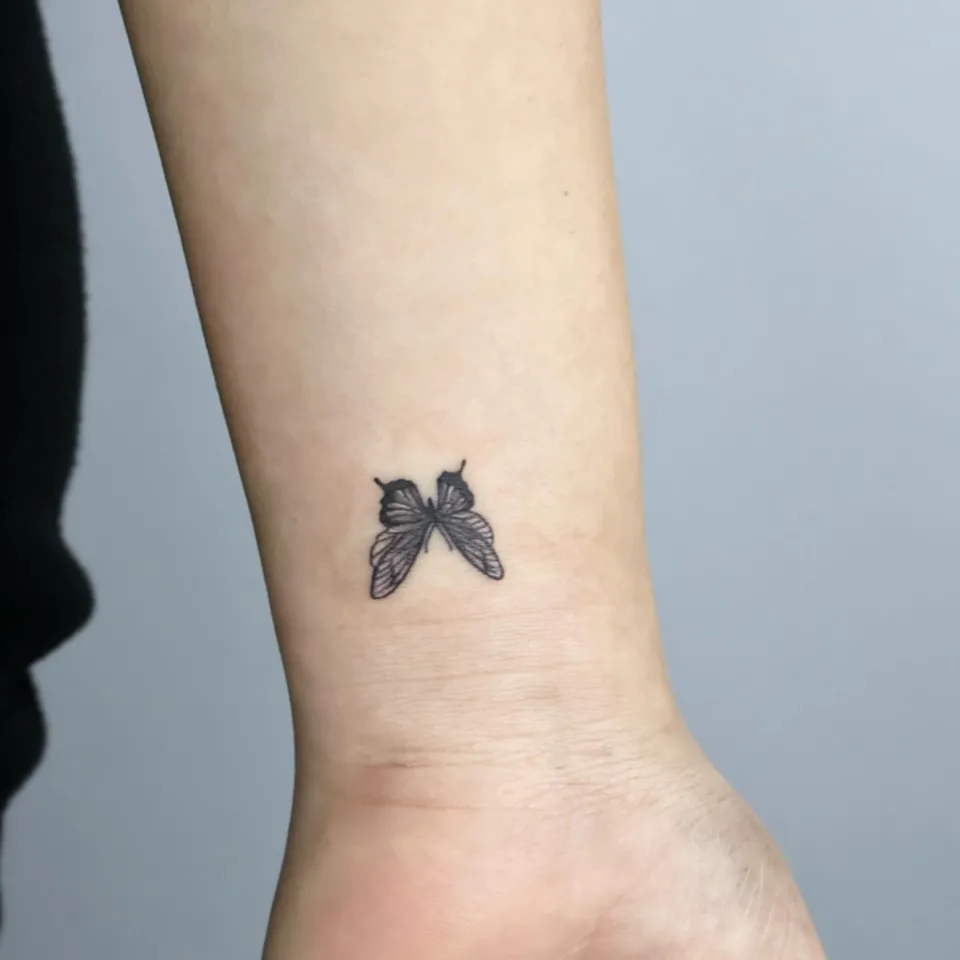
I tattooed one butterfly on the wrist, at the size of a Korean 100-won coin. The post was tagged with black tattoo and blackwork, so this is a black-ink piece. I'm grateful to the person who came to see me for it.
That is the whole case as it was shared: one motif, one spot, one clear size. The post does not give a reason for choosing a butterfly, so I won't guess at one. What we can talk about honestly are the design, the placement and the size.
This kind of piece makes a good teaching example because there are so few variables. With only one butterfly, the questions are simple. How big should it be? Where on the wrist should it sit? How bold or fine should the black shapes be? Those are the same questions behind almost every small women's tattoo, whatever the motif.
A single small motif also leaves room for decisions later. Some people like to keep it as one quiet mark, and others like knowing it could be joined by something else someday. Either way, the starting point is the same: a clear idea of size and position.
What design decisions does this piece show?
From the caption and tags, here is what we can say about the choices in this piece. I am keeping to what the post states and not describing anything beyond it.
| Item | What the post states | Why it matters |
|---|---|---|
| Motif | One butterfly | A single motif keeps the design easy to read at a small size |
| Placement | Wrist | A spot that is easy to see and easy to cover or show |
| Size | About a Korean 100-won coin | A concrete, familiar reference you can picture before booking |
| Ink | Black, tagged as blackwork | Solid black shapes give clear contrast on the skin |
The most useful lesson here is how a single reference object, a coin, turns a vague idea like "small" into something you can picture. "Small" means different things to different people. A coin-sized butterfly is a shared, concrete idea, and it is easy to check in the mirror.
A second lesson is restraint. When there is one motif and one color of ink, the placement and size carry most of the design. That is why those two decisions deserve real time before the day of the tattoo.
How do you choose the right size for a small tattoo?
Many people find it easiest to begin with a physical reference. Hold a coin against the spot, or cut a paper shape and tape it there. Then look at it in the mirror, from a normal standing distance, not only up close. A size that feels tiny on a screen can feel quite different on the body.
It also helps to think about how much detail the design contains. A butterfly has wings, edges and inner shapes, and the smaller the tattoo, the less room there is for each of those parts. In general, a smaller piece works better with simpler shapes and some breathing space between lines. A larger piece can hold more detail, though it also takes up more of the area.
Here are a few questions I would suggest asking yourself:
- Do I want this to read as a small accent or as a clear statement?
- Is the design mostly solid shapes, or does it depend on fine lines?
- Will I be happy with this size when I look at it every day?
If you are unsure, tell the artist how you picture it, and bring reference images. The size can then be discussed against the actual design instead of in the abstract.
How do you choose the right placement?
Placement is partly about the body and partly about your daily life. Many people ask themselves how often they want the tattoo to be visible. The wrist is easy to see and easy to show, and a sleeve or a watch can also cover it, depending on your clothes and routine.
It helps to think about movement too. The wrist bends, turns and sits in view when you hold a cup, type or read, so a tattoo there is something you will glance at often. A small, clear motif like a single butterfly suits a spot you see this regularly, because it stays readable without being busy.
Other practical points are worth checking before you decide. Consider whether you wear a watch or bracelet in the same spot, what your workplace or school expects, and which side of the body feels natural to you. Ask the artist how the design will sit once it is placed, since a motif can look different depending on the angle.
If you would like to see how tattoos are made and discussed in the studio, you can [watch the tattoo films](/films) to get a sense of the process before you come.
What do people often wonder about small butterfly and wrist tattoos?
One common question is whether a coin-sized tattoo will feel too small. The honest answer is that it depends on what you want from it. Some people like a small mark that feels personal and quiet, while others find that they want a bit more presence. Trying a paper cutout for a day or two is a simple way to find out.
Another question is about meaning. Butterflies are a popular motif, and many people attach their own personal meaning to them. Because meaning is personal, it is worth deciding what the tattoo means to you before you talk to the artist. Then the design choices, such as size, position and how bold the shapes are, can follow that idea instead of the other way around. In this case the post does not state a reason, so I leave the meaning open.
People also ask whether a small tattoo can be changed or added to later. That is a conversation to have with your artist, and it is easier if you mention it at the start. If you want more notes like this, you can [read more work notes](/journal) on the studio journal.
Finally, many people wonder whether black ink alone is enough. Black-only designs, often called blackwork, rely on shape and contrast instead of color. That can suit a simple motif well, as long as the size gives the shapes enough room.
Checklist: what should you prepare before a consultation?
Coming to a consultation with a few decisions already made makes the conversation more useful. You do not need everything settled, but a rough idea of the points below helps the artist understand what you want.
- [ ] Pick a motif, or at least a rough direction, and save a few reference images
- [ ] Choose the area of the body you are considering, and note how visible you want it to be
- [ ] Try a paper cutout or a coin at the spot to test the size
- [ ] Decide whether you prefer solid black shapes or finer lines
- [ ] Think about jewelry, clothing or dress codes that affect the spot
- [ ] Write down any questions about meaning, design changes or later additions
If something on the list is still unclear, that is fine. Bring what you have, and we can work through the rest together. The goal is a design whose size and placement feel right to you, not one that follows a rule.
The wrist butterfly in this article is a good reminder that a simple idea, one motif, one spot and one clear size, can be a complete tattoo. Take your time with those three choices.
Let’s talk about a tattoo that feels like you
Bring reference photos and tell us your preferred motif, size and placement.
Before you book
What size is a good starting point for a small women's tattoo?
There is no single right size. A familiar object such as a coin is a handy reference, as in this wrist butterfly at the size of a Korean 100-won coin. Test the size with a paper cutout and adjust it to the amount of detail in the design.
Is the wrist a good place for a first tattoo?
It is a popular spot because it is easy to see and easy to cover. Think about your daily routine, jewelry and any dress codes, and talk through the placement with your artist.
Can a small tattoo include a lot of detail?
Smaller sizes leave less room for fine detail, so simpler shapes with some space between lines usually read more clearly. Your artist can suggest how much detail suits the size you want.
Do I need a meaning before I book a tattoo?
No. Some people have a clear meaning in mind and others simply like the motif. If you do have a meaning, sharing it helps guide choices about wording, size and placement.
What should I bring to a consultation?
Bring reference images, a rough idea of the placement, and your questions. A paper cutout showing the size you have in mind is also very helpful.
Key facts
- Location
- 2F, G Studio, 136-11 Eoulmadang-ro, Mapo-gu, Seoul, South Korea
- Opening hours
- Mon–Sat 11:00–23:00 · Closed on Sundays
- Artist
- Yeonjae · China Academy of Art graduate · eighth year in Hongdae (as of 2026)
- Styles
- Fine line · Floral & botanical · Cover-up
- Consultation & booking
- Confirmed after consultation via Instagram DM, LINE or KakaoTalk
- Pricing & time
- Price and session length depend on the design, size and placement, and are explained during the consultation.
China Academy of Art graduate · eighth year as a tattoo artist in Hongdae · as of 2026
China Academy of Art is an art university founded in Hangzhou in 1928. Its long history of art education provides context for Yeonjae’s fine-art background. About the academy · official website ↗
Yeonjae Tattoo · Blog
Photos in this post: 1 real work photo
This post brings together the work photographs, published descriptions and guidance for preparing an inquiry. See the artist profile above for the creator’s background.
Original Instagram caption
Based on the artist’s supplied work notes. Editorial text was prepared with AI assistance.