What makes a good lettering tattoo phrase?
Hi, I'm Yeonjae, a tattoo artist in Hongdae, Seoul. If you're wondering how to choose a lettering tattoo phrase, the short answer is this: pick words that carry a feeling you want to keep close, keep them short enough to be read clearly, and make sure they still feel right when your mood changes. Those are the three criteria this article is built around.
A lettering tattoo is different from most other designs because the meaning is spelled out. There is no symbol for the viewer to interpret, so they read exactly what you chose. That is why the wording itself is the most important design decision, and why it deserves more time than the font or the size.
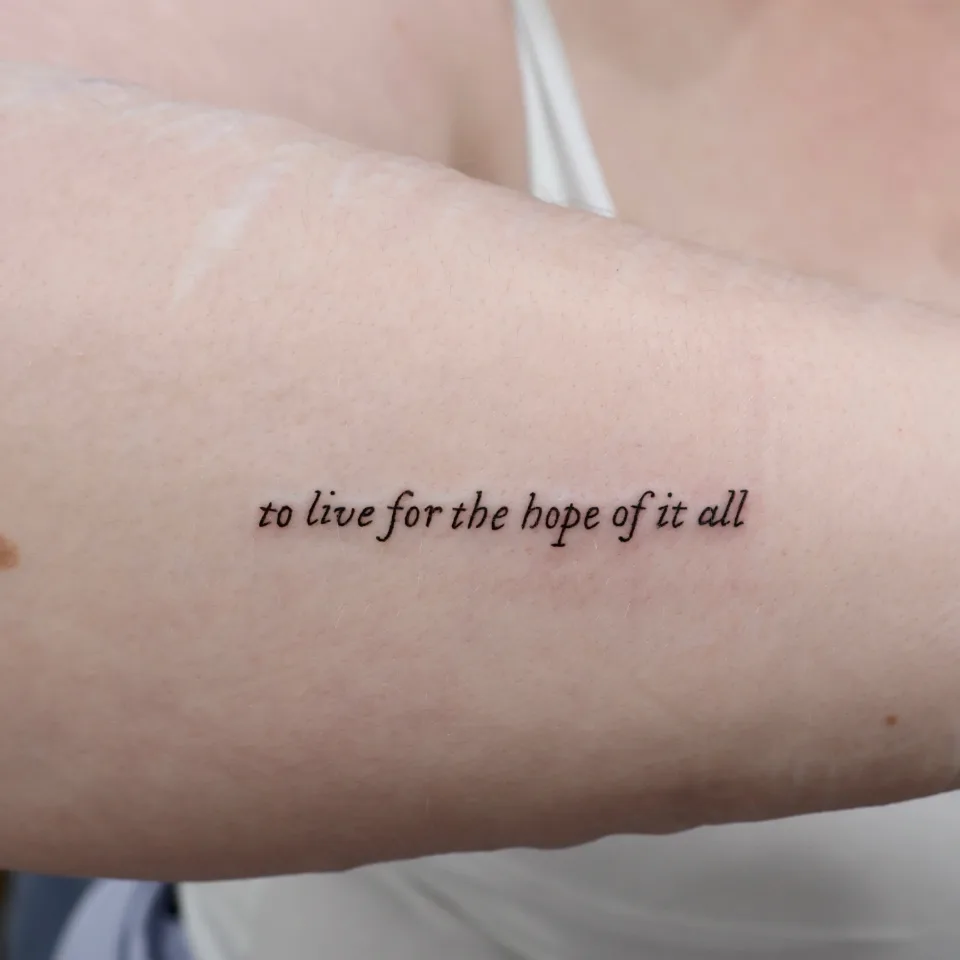
To keep this practical, we'll start with one real piece, a small lettering tattoo that reads "to live for the hope of it all," and then turn it into general guidance. You'll find the three criteria, the kinds of sentences people tend to consider, notes on wording, size and placement, and a checklist for before you book a consultation.
How did the "to live for the hope of it all" piece come together?
The original post introduces it as a simple lettering tattoo that carries a quiet reminder: keep living with hope, even through uncertain moments. The sentence reads "To live for the hope of it all."
The feeling behind it is the wish to hold on to hope in every moment. The sentence is short, but the tattoo was worked so that its meaning, the sense of being able to move forward again even in hard moments, can be kept close for a long time.
One line from the caption explains why people choose this kind of tattoo: sometimes a short sentence can hold a feeling you want to keep near for a long time. The post was also shared in Korean and Chinese. Each version says the same thing in its own words: living with hope whatever you go through, and using a few words as a reminder to keep going when things feel low or unclear.
The post says nothing about the person who wears it, and that stays private. What we can learn from it is how the piece is built. It rests on a single short sentence, so the choice of phrase is what makes the tattoo what it is.
What are the 3 criteria for choosing a lettering tattoo phrase?
Here are the three questions I'd suggest asking before you settle on any words. They work for a sentence of three words or thirteen, in any language.
1. Does the phrase hold a feeling that is really yours? The strongest phrases usually start from a feeling you want to keep nearby, not from something that merely sounds good. In the hope tattoo above, the feeling is clear: living with hope in every moment. If you can explain in one sentence why you want these particular words, you're on the right track.
2. Is it short and clear enough to read? Lettering is read at a glance, and every extra word means smaller letters or a larger area. A short sentence leaves room for the letters to stay clean and legible. The hope sentence is short, yet it still says a complete thing, and that's the balance to aim for.
3. Will it still feel right when your mood changes? A phrase tied to a single event can feel different later. A phrase that speaks to a recurring feeling, like needing encouragement in uncertain moments, tends to stay relevant. Try living with the words for a while, for example as a note on your phone, before you commit.
| Criterion | Question to ask yourself | How it shows up in this piece |
|---|---|---|
| Meaning | Can I say why these words matter to me? | A wish to live with hope in every moment |
| Length | Is it short enough to read clearly? | One short sentence |
| Staying power | Will it still fit when my mood shifts? | Wording aimed at uncertain moments, not one event |
What types of sentences do people turn into lettering tattoos?
In general, the phrases people consider tend to fall into a few families. This is general guidance rather than a list of past clients, but it can help you see where your own idea belongs.
Hope and encouragement. Sentences meant to lift you up on a hard day. The sentence in our real example belongs here: a quiet reminder to keep going with hope. These work well because the feeling is universal but the exact words are personal.
Reminders and promises to yourself. Short statements about how you want to live or what you want to remember. They are usually direct, which suits lettering well.
Words from songs, books or films. These can carry a lot of meaning, but it helps to check that you have the exact wording and spelling, and that the line still means something to you without its original context.
Names, dates and single words. Very compact and easy to read, though the meaning is more private and may need a second look on how much you want others to understand.
Phrases in another language. These add a layer of personal meaning, but they need extra care, which we cover below.
If you'd like more notes on how different pieces are approached, you can [read more work notes](/journal) on the blog. Whichever family your phrase belongs to, the three criteria from the previous section still apply.
How do wording, size and placement shape a short sentence?
Once the phrase is chosen, small decisions decide how it actually reads. Wording comes first. Even capitalization and punctuation are choices. The original post writes the sentence both with a capital "T" and in all lowercase, which is a good reminder to decide in advance exactly how you want it to appear, including whether it ends with a period.
Size and length go together. A longer sentence needs either more room or smaller letters, and smaller letters are harder to read at a glance. If your phrase feels long, consider whether a shorter version keeps the same feeling. Often it does, and the result looks calmer.
Placement matters because lettering follows a line. A sentence reads most naturally along a body area that gives it a clear, steady path. I won't describe where the hope tattoo sits, because the source material doesn't say. In general, though, it helps to bring a few ideas for where you picture the words, and to talk through how the line will sit when you move, not only when you stand still.
Finally, think about how visible you want it to be. Some people want a phrase they can read themselves whenever they look down. Others prefer something more private. Neither is wrong, but the answer affects size, placement and even how much of the sentence you keep.
What do people often wonder about phrases in another language?
Many people ask whether it's okay to tattoo a phrase in a language that isn't their first. It can be a lovely choice, since the words may feel more personal or simply sound the way you want them to. The key is to be sure of the meaning.
The original post offers a small example. The same hope sentence appears in English, Korean and Chinese, each worded naturally in its own language instead of copied word for word. That's a useful habit: a good phrase in one language often needs rephrasing, not a literal translation, to carry the same feeling in another.
A few general tips help here. Ask a fluent speaker to read your phrase and tell you how it sounds, not just whether it's correct. Check spelling and spacing carefully, because one wrong letter is hard to ignore once it's on your skin. And think about whether you'd be comfortable if someone who speaks that language read it without any explanation from you.
If you want to see how finished lettering pieces look in motion, you can [watch the tattoo films](/films) to get a feel for line, spacing and scale before you decide on your own design.
What should you check before booking? A lettering phrase checklist
Before a consultation, a little preparation makes the conversation much easier. You don't need a finished design, but the more clearly you can describe the words and the feeling behind them, the more useful the discussion will be. If you're thinking about a studio in the area, the [Hongdae tattoo guide](/hongdae-tattoo) can help you plan your visit.
Here is a simple checklist to bring with you:
- [ ] I can write my phrase out exactly, including spelling, capital letters and punctuation.
- [ ] I can explain in one sentence why these words matter to me.
- [ ] I've lived with the phrase for a while, for example saved on my phone, and it still feels right.
- [ ] If the phrase is in another language, someone fluent has checked the meaning and the wording.
- [ ] I have a rough idea of the size and the area of the body I'm considering.
- [ ] I've thought about how visible or private I want the words to be.
- [ ] I'm open to hearing whether a shorter version might read more clearly.
If you can tick most of these, you're well prepared. If you can't yet, that's fine too: the point of a consultation is to work through the open questions together before anything is decided.
Let’s talk about a tattoo that feels like you
Bring reference photos and tell us your preferred motif, size and placement.
Before you book
How long should a lettering tattoo phrase be?
There is no fixed number, but shorter is generally easier to read and gives the letters more room. If your sentence feels long, try a shorter version that keeps the same feeling and compare the two.
Can I choose a quote from a song or a book?
Yes, many people do. It helps to confirm the exact wording and spelling, and to make sure the line still means something to you on its own, without the song or book around it.
Should I use English, or the language I speak every day?
Either can work. What matters is that you understand every nuance of the words. If you choose a language that isn't your first, ask a fluent speaker to read it and tell you how it sounds.
Do capital letters and punctuation matter in lettering?
They do, because they change how the sentence looks and reads. Decide in advance whether you want capitals, lowercase or a final period, and bring the exact version to your consultation.
Key facts
- Location
- 2F, G Studio, 136-11 Eoulmadang-ro, Mapo-gu, Seoul, South Korea
- Opening hours
- Mon–Sat 11:00–23:00 · Closed on Sundays
- Artist
- Yeonjae · China Academy of Art graduate · eighth year in Hongdae (as of 2026)
- Styles
- Fine line · Floral & botanical · Cover-up
- Consultation & booking
- Confirmed after consultation via Instagram DM, LINE or KakaoTalk
- Pricing & time
- Price and session length depend on the design, size and placement, and are explained during the consultation.
China Academy of Art graduate, in her eighth year as a tattoo artist in Hongdae · as of 2026
China Academy of Art is an art university founded in Hangzhou in 1928. Its long history of art education provides context for Yeonjae’s fine-art background. About the academy · official website ↗
Yeonjae Tattoo · Blog
This post brings together the work photographs, published descriptions and guidance for preparing an inquiry. See the artist profile above for the creator’s background.
Original Instagram caption
Based on the artist’s supplied work notes. Editorial text was prepared with AI assistance.